Anyone with a chainsaw and a pickup can print business cards that say “tree service.” That is not a knock on small operators; plenty of good ones started that way. It is a reminder that in Florida, the job of vetting a tree company falls mostly on the homeowner. Tree work is also one of the few home services where one bad cut can put a limb through a roof or a person in the hospital. Here is the checklist we would want a family member to use before hiring anyone, us included, for tree work in Polk County.
Why hiring a tree company takes homework in Florida
Start with an uncomfortable fact: the State of Florida does not require tree trimming or tree removal companies to hold a state license. Marion County’s emergency management office says it plainly, and it also notes that the Florida Department of Agriculture and Consumer Services does not regulate or license tree service companies. You cannot type a tree company’s name into the state’s license lookup and get a clean yes or no the way you can for a roofer, plumber or electrician.
Local licensing is thin too. In 2021 the Legislature passed a law, now section 163.211 of the Florida Statutes, that preempts occupational licensing to the state. Local licenses that already existed were set to expire in 2023. Broward County, which once required tree trimmers to hold a local certificate of competency, stopped requiring it as of July 1, 2025 because of that law. So a missing license number is not automatically a red flag, and a license number you are shown may not mean much. What protects you is insurance, paperwork, and a few minutes of checking.
What a business tax receipt does and does not prove
Most companies working in Polk County should have a county local business tax receipt, and some cities issue their own on top of it. The Polk County Tax Collector lists these receipts in a public online search, so it is worth a look. Just understand what it means. The Tax Collector states that a receipt gives the holder the privilege of doing business in the county and does not acknowledge competency in any trade. The Florida Department of Business and Professional Regulation makes the same point in its hurricane-season guidance: an “occupational license” only means the person paid a local tax.
Treat a tax receipt as a sign the business is established, not as proof it can safely drop a 70-foot pine next to your house.
Proof of liability and workers’ comp insurance
This is the part of hiring that actually protects your property and your wallet. Ask every company for two documents before you sign anything:
- General liability. This pays if the crew damages your home, pool cage, fence, car or a neighbor’s property. Ask for a certificate of insurance, then do what the Florida Attorney General recommends after storms: call the insurer and confirm the policy is current. A certificate emailed from last year’s policy proves nothing.
- Workers’ compensation. Tree work is dangerous. The Florida Department of Financial Services requires construction-industry employers with one or more employees, and most other employers with four or more, to carry workers’ comp. You can look up a company in the Division of Workers’ Compensation Proof of Coverage database. If the company shows only an exemption, know that exemptions are for business owners opting out of coverage for themselves. An exemption does nothing for the helper on your roof.
For what it is worth, we carry $2 million in liability coverage and hand over the paperwork before any saw starts on a tree removal job. Any reputable company should do the same without being asked twice.
What a good written estimate includes
Verbal quotes lead to arguments on removal day. Get the estimate in writing and make sure it spells out:
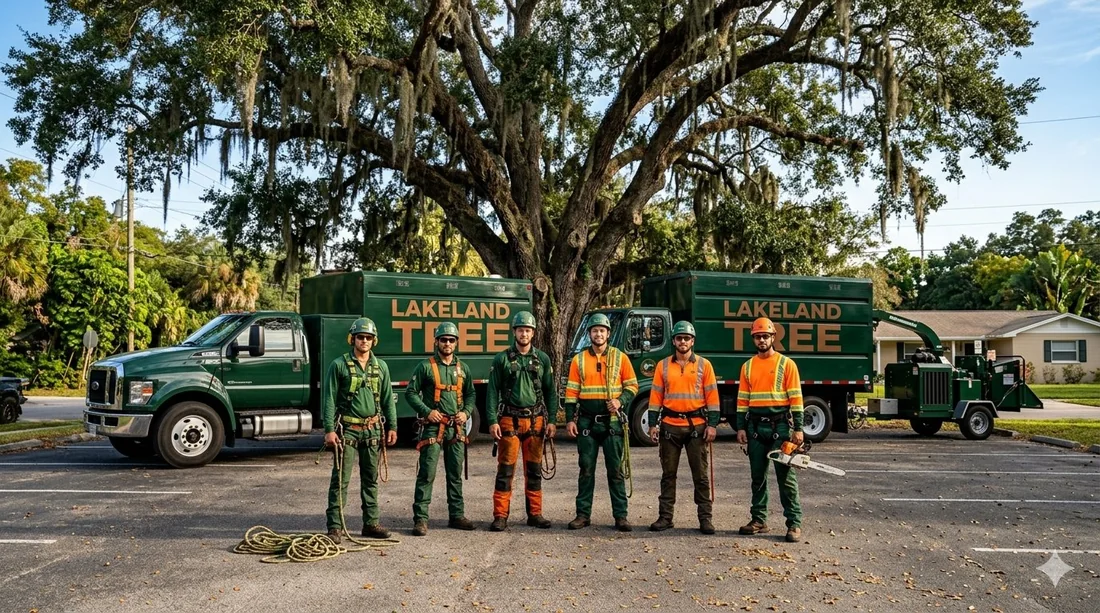
- Exactly which trees are coming down or being pruned. Mark them with tape or flag them in photos if there is any doubt.
- Whether debris hauling is included, or whether logs and brush will be left in a pile. The Attorney General specifically tells homeowners to ask this.
- Whether stump grinding is included, and how deep.
- Who handles permit research and any permit fees. Rules differ between Lakeland, Winter Haven, Plant City and unincorporated Polk. Our tree permit guide for Lakeland covers the basics.
- Payment terms. The Attorney General warns never to pay the full amount upfront, and not to make final payment until you are satisfied with the work.
Get more than one estimate on big jobs. If you want to sanity-check the numbers, our tree removal cost guide walks through what moves the price.
Storm-chaser red flags after a hurricane
After a hurricane, unfamiliar trucks start knocking on doors. Some belong to honest crews from out of town who came to help. Others do not. After Hurricane Milton, the Florida Attorney General warned that qualified contractors book up fast after a disaster, and that scammers and unqualified out-of-state workers move in to fill the gap. Its tree-removal tips boil down to this:
- Be wary of anyone who approaches you unsolicited about tree removal.
- Get multiple written estimates and ask whether debris removal is included.
- Research the company and verify its insurance with the insurer.
- Never pay in full upfront.
We would add a few local warning signs: no local address or phone number, pressure to sign an insurance assignment on the spot, a crew that wants to start cutting before you have anything in writing, and cash-only deals. If a tree is on your house, call a known emergency tree service first, then your insurer. The Attorney General takes price-gouging reports at 1-866-9NO-SCAM and through its No Scam app, and DBPR runs an unlicensed activity hotline at 1-866-532-1440 for work that does require a state license, such as roofing.
Arborist credentials you can check yourself
Because Florida has no state tree license, voluntary credentials matter more here. The best known is the ISA Certified Arborist credential from the International Society of Arboriculture. It requires passing an exam and earning continuing education to keep it. The ISA runs a public verification tool where you can search by name or credential number and see whether a credential is active. Ask for the number, then look it up.
The ISA Tree Risk Assessment Qualification is also worth knowing about. Under Florida Statute 163.045, a homeowner with documentation from an ISA certified arborist or a Florida licensed landscape architect showing that a tree poses an unacceptable risk can prune or remove it without a local permit. If you are relying on that law, the person signing the letter needs the right credential.
A credential is a good signal of knowledge, but not every job needs one. Routine tree trimming or removing a dead pine is mostly about skilled climbing, rigging and insurance. What matters is that nobody claims a credential they cannot show you.
Questions to ask before tree cutting starts in Lakeland, Winter Haven or Bartow
- Who will be on site, and who is in charge if something goes wrong?
- How will you protect the lawn, pavers, irrigation and pool enclosure?
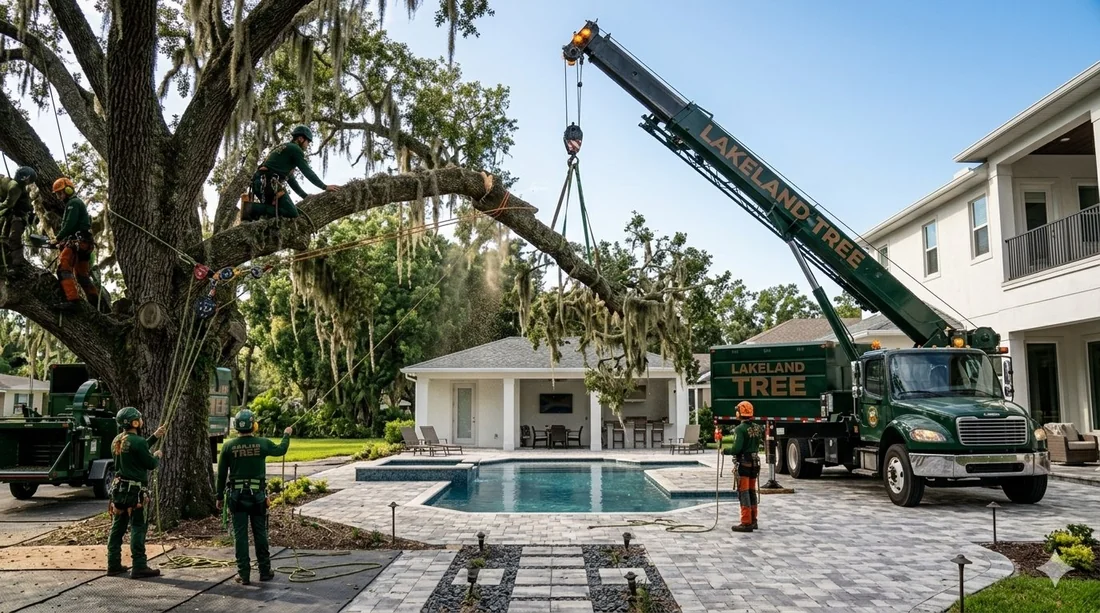
- Will the tree be climbed, rigged, or cut with a crane or bucket truck?
- Who calls the utility if limbs are near a service line? Lakeland Electric, TECO, Duke Energy and the City of Bartow Electric Department each serve parts of our area.
- What happens if the job takes longer than planned? Is the price fixed?
Good companies answer these without getting defensive. We work from our Lakeland base across tree removal in Lakeland, Winter Haven tree service, tree cutting in Bartow, Auburndale and tree removal in Plant City, and we are happy to be vetted the same way.
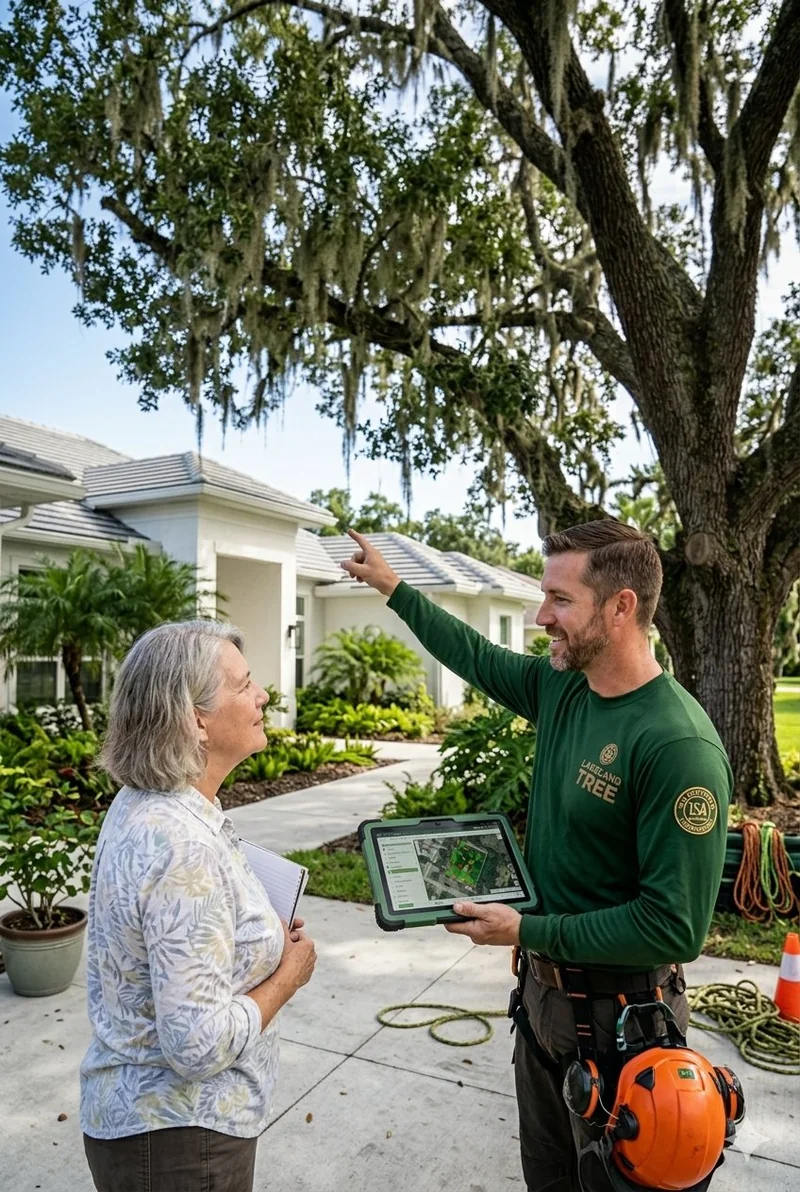
Ready to compare estimates? Call (813) 725-9787 or request a free written quote. We will walk the property with you, put everything in writing, and send our insurance paperwork before the job starts.
Need a Lakeland tree quote?
Free written estimates within 24 hours. No pressure, no hidden fees.
Get a Free Quote →