
Tree removal in Lakeland isn’t something to take lightly. Polk County’s Live Oaks, Laurel Oaks, and Slash Pines often grow within feet of houses, pools, and power lines — and a single bad cut can mean a five-figure repair bill. That’s why every Lakeland tree removal we do starts with a free on-site assessment, an itemized written estimate, and full liability insurance documentation before a single saw fires up.
Whether it’s a dead pine near your driveway, a leaning oak threatening your roof, or just a tree you simply want gone, we handle every Lakeland tree removal from start to finish — including permit research, neighbor coordination, debris haul-away, and final cleanup. Most jobs are scheduled within 3-7 days of accepted estimate.
Lakeland Tree Removal: What Every Job Includes
Our standard tree removal process covers everything most homeowners forget to ask about until it’s too late:
- On-site assessment — we inspect the tree, the access route, and any obstacles like irrigation, pavers, or fence panels
- Written estimate — itemized line items, no surprises, valid 30 days
- Permit handling — if the City of Lakeland or Polk County requires a tree-removal permit, we pull it
- Property protection — access mats for lawns, plywood for pavers, tarps for pool decks
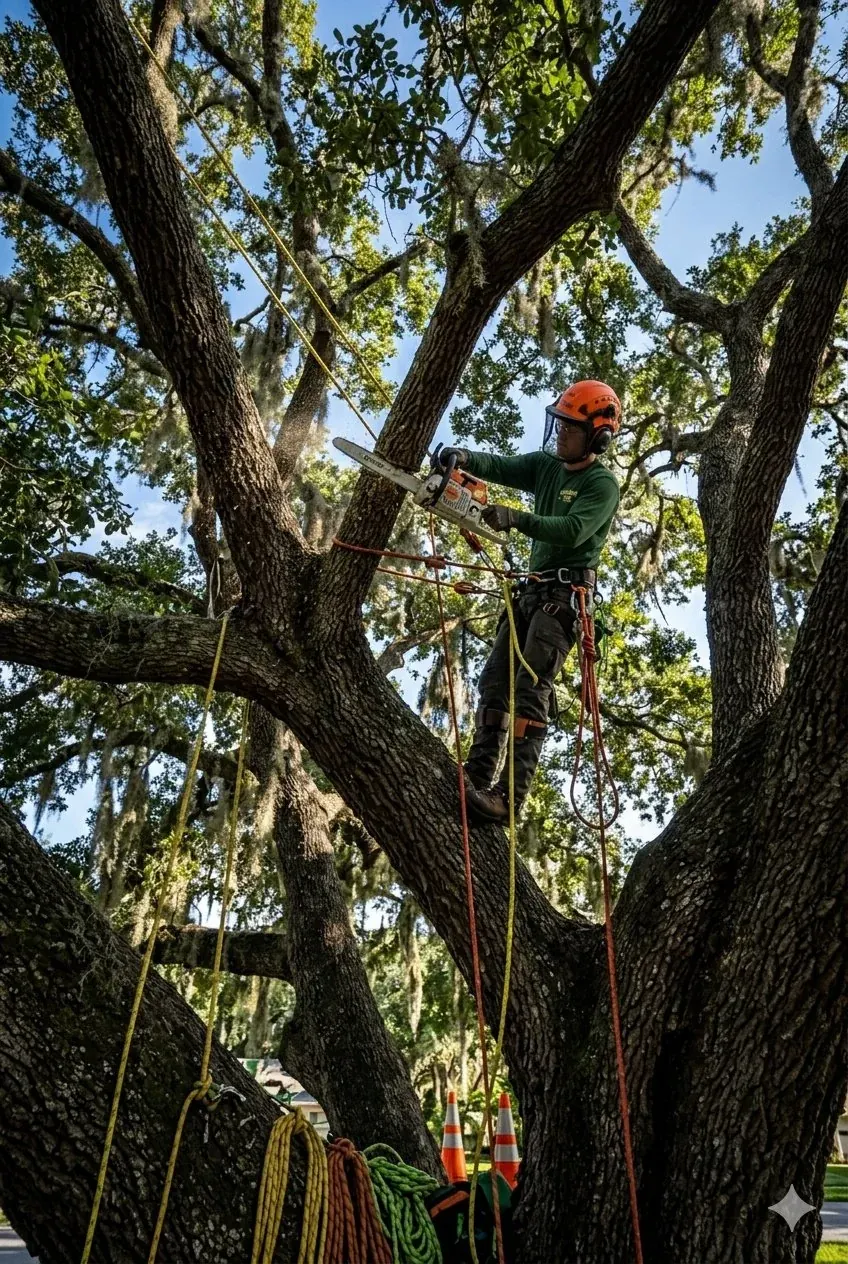
- Surgical takedown — rigging, crane, or climbing depending on the tree
- Complete debris removal — every branch, log, and chip hauled away
- Final rake — we don’t leave your yard worse than we found it
We remove every species common to Lakeland and Polk County — Live Oaks, Laurel Oaks, Water Oaks, Slash Pines, Longleaf Pines, Sand Pines, Bald Cypress, Camphor, Magnolia, Sweetgum, Hickory, Maple, Sycamore, Ficus, Citrus, and all Florida palm species including Sabal, Queen, Royal, Date, and Washingtonian palms.
Tree Removal Cost in Lakeland, FL: Real Price Ranges
Lakeland tree removal pricing depends on five main factors: tree height, trunk diameter (DBH), species, proximity to structures, and access. Here are real ranges from recent Polk County jobs:
- Small trees (under 30ft): $375 – $700 — small palms, smaller hardwoods, young pines
- Medium trees (30-60ft): $750 – $1,500 — most residential oaks, mature palms, mid-size pines
- Large trees (60-80ft): $1,600 – $2,800 — mature Live Oaks, large Slash Pines, tall Royal palms
- Heritage / hazardous (80ft+ or near structures): $2,800 – $5,000+ — grand oaks, crane-required jobs, trees on houses
Stump grinding is typically not included in the removal price — expect to add $100-$400 per stump if you want it ground below grade. Bundle pricing is usually available if you book removal + grinding together.
Dead Tree Removal Lakeland: Why Waiting Costs More
A dead tree does not stay the same size problem. Once the wood stops getting water, it dries, checks, and loses the flexibility that lets a living tree bend in a thunderstorm. Dead pines in particular tend to shed tops and limbs without warning, and a trunk that is hollow at the base can snap at the soil line. Every month you wait usually means more brittle wood and less safe ways to climb it, which is why a dead tree removal can shift from a routine climb-and-rig job to a bucket-truck or crane job.
Signs a tree is dead or dying rather than just dormant include bark sloughing off in sheets, no new leaves after spring flush, mushrooms or shelf fungi at the base, and cracks in the trunk. Our guide to signs your tree is dying in Lakeland walks through what to look for. Dead-tree rules also differ by city: Winter Haven, for example, exempts dead, diseased, and fallen trees from its tree permit, while in Lakeland we check the City’s regulated-tree list before any cut. If we find the tree is already failing near your home, our emergency tree service line is open 24/7.
Tree Cutting Service in Lakeland Near Houses, Pools & Fences
Most of the tree removals we quote in Polk County are not open-yard drops. They are trees growing a few feet from a roofline, leaning over a screened pool cage, or rooted right against a fence line shared with a neighbor. None of those can be felled in one piece, so the tree comes down in controlled sections: limbs are cut and lowered on ropes, the trunk is taken down in short pieces, and nothing is allowed to free-fall onto a structure.
- Near the house: limbs over the roof are removed first, working from the outside in, so the canopy is gone before anyone cuts the trunk.
- Near a pool or screen enclosure: pieces are lowered away from the cage, and we protect decks and pavers before the first cut.
- On a fence line: we talk through whose side the stump sits on and how the neighbor’s yard will be protected.
Trees this close to structures are also the stumps people most often want gone afterward, so ask about pairing the job with stump grinding. We handle these tight-access removals from Lakeland to tree removal in Plant City.
Removing a Tree in Lakeland Without a Permit: Florida Statute 163.045
Florida Statute 163.045 limits what local governments can require for trees on residential property. If the property is a single-family detached home and the owner has documentation from an ISA certified arborist or a Florida licensed landscape architect that the tree poses an unacceptable risk to persons or property, the city or county may not require a notice, application, approval, permit, fee, or mitigation to prune, trim, or remove it, and may not require a replacement tree.
A few details matter:
- The documentation must come from an onsite assessment that follows the ISA tree risk assessment best management practices.
- Unacceptable risk means removal is the only practical way to bring the risk below a moderate level.
- The law covers single-family detached homes, not commercial lots or most multifamily property.
For healthy trees that are simply in the way, local rules still apply. Lakeland regulates living pines 12 inches in diameter and larger plus certain listed species, and Plant City protects native trees 5 inches and larger. Read our full tree removal permit guide for Lakeland, or see local notes for tree removal in Bartow.
Tree Removal Near Me: Lakeland & Polk County Cities
We provide tree removal throughout our service area. See local details, neighborhoods, and FAQs for your city:
- Tree removal in Lakeland, FL
- Tree removal in Winter Haven, FL
- Tree removal in Auburndale, FL
- Tree removal in Bartow, FL
- Tree removal in Mulberry, FL
- Tree removal in Plant City, FL
- Tree removal in Polk City, FL
- Tree removal in Lake Wales, FL
- Tree removal in Haines City, FL
- Tree removal in Davenport, FL
- Tree removal in Lake Alfred, FL
- Tree removal in Eagle Lake, FL
- Tree removal in Fort Meade, FL
- Tree removal in Dundee, FL
- Tree removal in Lake Hamilton, FL
- Tree removal in Kathleen, FL
- Tree removal in Highland City, FL
Get a Free Lakeland Tree Removal Quote
Free on-site estimates, written quotes within 24 hours, and zero pressure. Call us or submit the form below.
Get a Free Tree Removal Quote →Tree Removal Lakeland FAQs
Most single-tree removals in Lakeland take 2-6 hours. A heritage Live Oak with crane assistance might run a full day. Multi-tree jobs are typically scheduled over 1-3 days depending on access and debris volume.
Stump grinding is a separate service we offer, but it’s not included in the tree removal price by default. Most homeowners bundle the two for a discount. We grind 8-14” below grade so you can replant or lay sod immediately.
No. We use plywood access mats on lawns, plywood over pavers, and tarps over pool decks. If a tree truly cannot be removed without yard damage, we tell you in writing during the estimate so you can decide.
It depends. The City of Lakeland regulates removal of grand trees (oaks and certain hardwoods above specific DBH thresholds). Unincorporated Polk County has its own rules. We handle all permit research and paperwork as part of every job.
We coordinate with Lakeland Electric or Duke Energy for any tree work within 10 feet of energized lines. In most cases the utility will trim or de-energize before we proceed.
Yes — $2M general liability + full workers compensation. We provide certificates of insurance on request before any work begins. Always verify your tree company is insured. One bad cut from an uninsured crew can become a $50,000 problem for the homeowner.
Generally no. Standard homeowners policies pay for tree removal when a tree falls on an insured structure from a covered peril, and removal is often capped at roughly $500 per tree and $1,000 per loss, so a preventive removal of a healthy or dying tree is usually an out-of-pocket cost. Check your own policy with your agent.
Possibly not. The City of Lakeland regulates living pines 12 inches in diameter and larger plus listed species, so a dead tree may fall outside that list, but confirm with the City of Lakeland (863-834-2233) or let us check before any cut. See our Lakeland tree permit guide.
There is no single number, but large trees whose canopy overhangs the roof or whose trunk sits within a few feet of the foundation, pool, or septic system are the ones we are most often asked to remove. We can look at the species, lean, and root area and tell you whether pruning or removal makes more sense.
Usually, yes. Mobilizing a crew, chipper, and any lift equipment is a fixed cost, so removing two or three trees in one visit typically costs less per tree than separate trips. Our tree removal cost guide breaks down the factors.
A tree whose trunk straddles the property line is generally treated as shared by both owners, so it is best to agree in writing with your neighbor before removal. We can quote the job and include both addresses on the estimate.
In most cases, yes. We ask where sprinkler lines and heads are, lower wood instead of dropping it where possible, and lay protection over pavers and turf along the access path.
Yes. Clearing trees ahead of a pool, room addition, or driveway is common, and we can also grind the stumps so your contractor starts with a clean site. Development-related removals can have different permit rules, so we check with the city first.