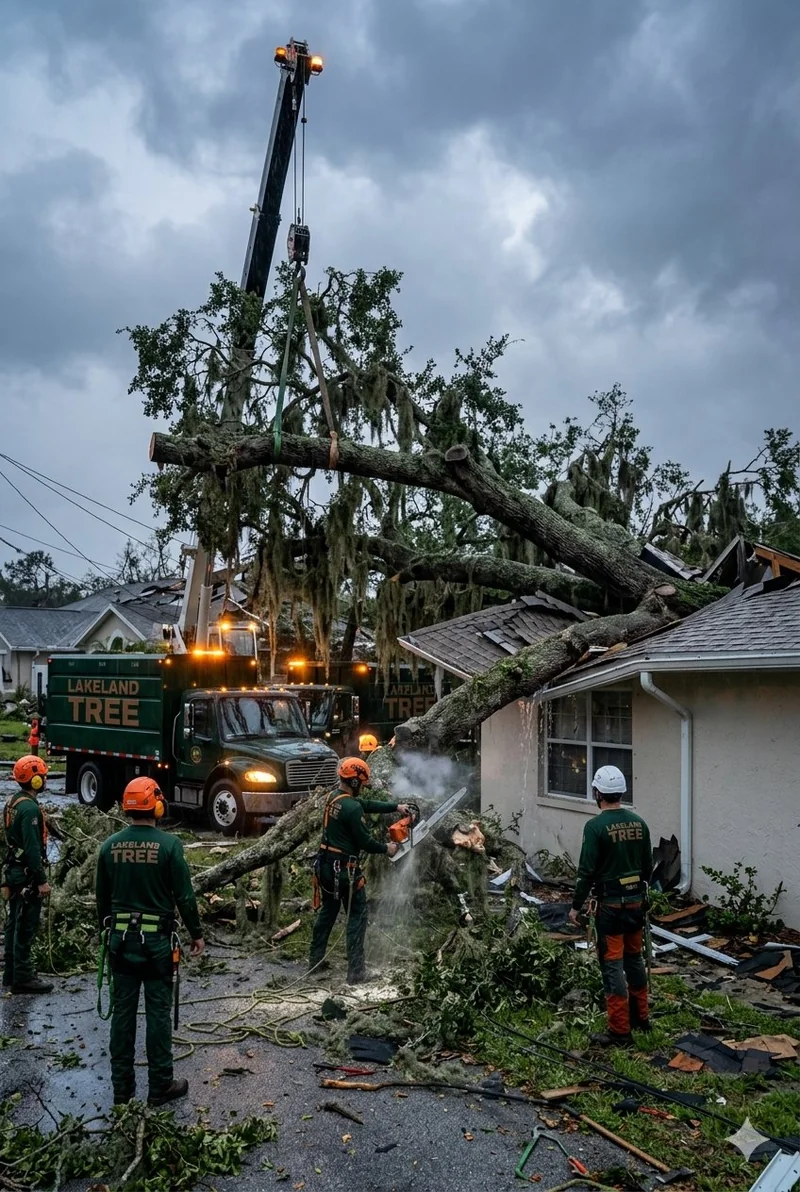
Trees don’t fail during business hours. They fail at 2 AM in the middle of a tropical storm, or 11 PM when a 60-year-old Laurel Oak finally gives up. Our 24/7 emergency tree service in Lakeland exists because we’ve been answering those calls for 16 years — and because Polk County has more hurricane-pruned trees waiting to fail than most homeowners realize.
If a tree is on your house, blocking your driveway, hanging on power lines, or leaning hard toward a structure — call us first, then the insurance company. We work directly with all major carriers (State Farm, Citizens, Allstate, USAA, Tower Hill, Heritage) and provide the documentation adjusters need.
What Counts as Emergency Tree Removal in Lakeland?
- Tree on a house or vehicle — same-hour response, insurance documentation included
- Tree blocking a driveway or roadway — typically same-day, often within hours
- Tree on power lines — we coordinate with Lakeland Electric or Duke Energy first
- Hazardous lean — visible root failure, cracked trunk, or imminent collapse
- Storm damage cleanup — broken limbs, hanging branches, fallen palms
- Post-hurricane recovery — bulk debris removal after Polk County storm events
If you’re looking at your tree right now wondering “is this an emergency or can it wait?” — call us and we’ll tell you honestly. We don’t upsell non-emergencies to emergency pricing.
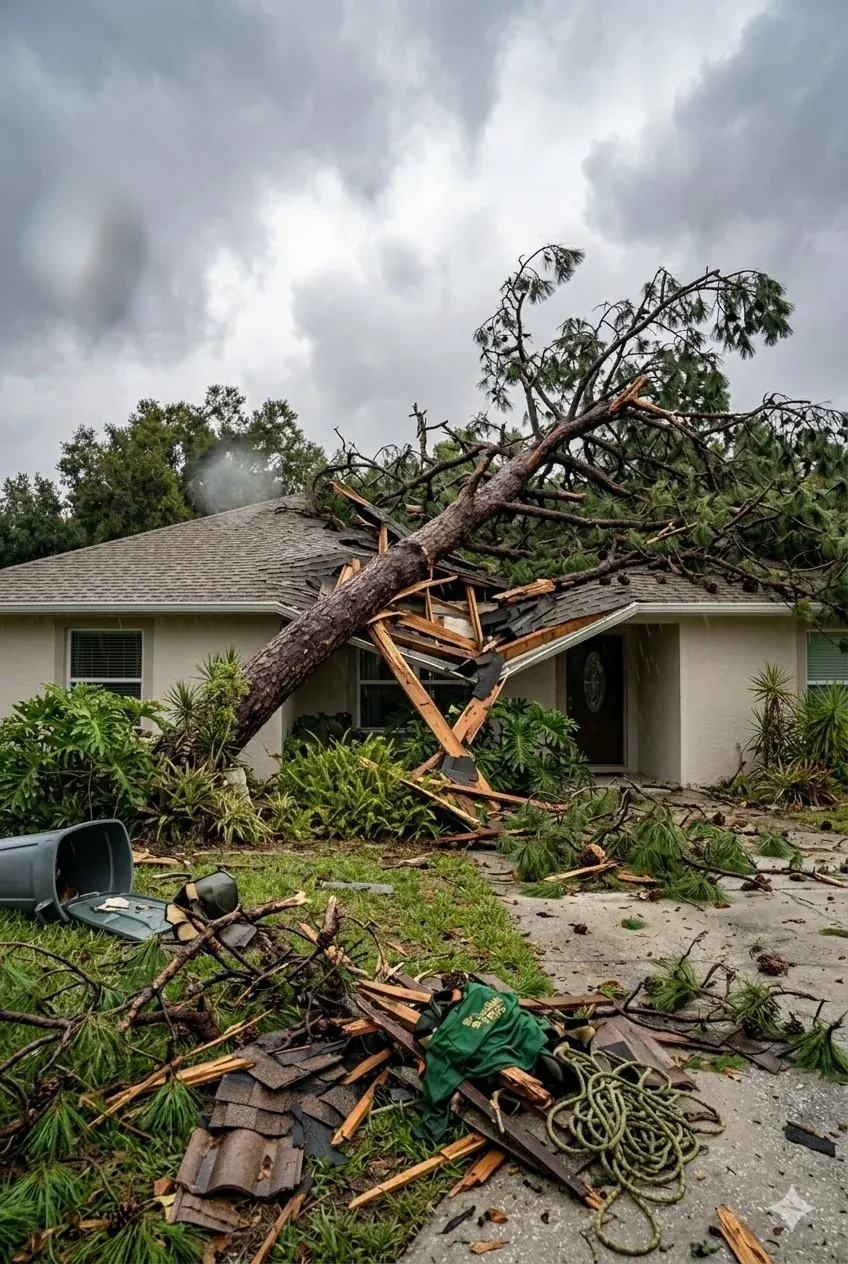
Lakeland Emergency Tree Service and Your Insurance Company
Most homeowners insurance policies in Florida cover emergency tree removal when:
- A tree falls on a covered structure (home, garage, fence, screen enclosure)
- A tree blocks access to your driveway or your home
- The fallen tree itself isn’t covered, but the damage it caused is
What we provide for the claim:
- Photo documentation before, during, and after removal
- Itemized invoice with line items insurers expect
- Description of the tree, damage, and any debris hauled
- Direct communication with your adjuster if needed
Most Lakeland insurance carriers reimburse for emergency tree removal within 30-60 days of submission.
24 Hour Tree Service Lakeland: Hurricane & Storm Response
During major Polk County storm events (Hurricane Ian, Irma, Idalia, Milton), our emergency response priorities are:
- Active hazards first — tree on structure with possible occupants
- Blocked access — trees keeping people from their homes
- Power line entanglement — coordinated with utility
- Standing hazards — leaning trees that haven’t fallen yet
- Bulk debris cleanup — once active hazards are clear
Plan ahead: our hurricane tree prep checklist covers what to do in May-June before storm season actually starts.
Tree Fell on a House in Lakeland? What to Do First
The first few minutes after a tree hits your home are about safety, not the tree. A practical order of steps:
- Get everyone out of the damaged rooms and away from any sagging ceiling or wall. Do not go back in to retrieve belongings.
- Treat every downed wire as live. Stay well clear and call 911 if lines are down or you smell gas, then report it to your electric utility.
- Photograph everything from a safe distance before anything is moved: the tree, the roof, interior damage, and any vehicles.
- Call your insurer to open a claim. Insurers expect you to take reasonable steps to prevent further damage, such as tarping a roof opening, and to keep receipts for that work.
- Hold off on permanent repairs until an adjuster has seen the damage.
A tree resting on a roof is often still loaded with tension, and cutting it the wrong way can drop more weight into the house. Our crews take it off in sections so you or your roofer can get the opening covered. We also document the removal with photos and an itemized invoice for your claim. Call our 24/7 line from Lakeland, emergency tree removal in Bartow, or anywhere in Polk County.
Tree on a Car, Fence or Neighbor’s Yard: Who Pays for Storm Tree Removal in Lakeland?
Who pays usually depends on what the tree landed on, not whose yard it grew in. General rules under standard homeowners policies (always confirm with your own agent):
- Your house or a covered structure like a fence or shed: your homeowners policy typically covers the damage if the tree fell from a covered peril such as wind, even if it was the neighbor’s tree. Tree removal is often capped at about $500 per tree and $1,000 per loss.
- Your car: homeowners insurance generally does not cover vehicles. Damage from a falling tree is usually claimed under the comprehensive coverage on your auto policy.
- Your tree onto a neighbor’s property: their insurer typically pays, but if your tree was visibly dead or poorly maintained and you did nothing, their insurer may seek reimbursement from you.
- Open yard, nothing hit: removal is usually not covered, though some insurers pay when a fallen tree blocks a driveway or accessibility ramp.
In Florida, a separate hurricane deductible, often a percentage of your dwelling coverage, applies to hurricane losses and applies once per calendar year. The best way to avoid a negligence dispute is to deal with dead trees early through tree removal or hazard pruning.
Storm Debris Removal in Lakeland & Polk County: Curbside Rules by City
After a storm, every homeowner wants the limbs gone, and many assume the city will take whatever is piled at the curb. Normal yard waste service has size limits, and they differ across Polk County:
- Lakeland: limbs up to 5 feet long and 5 inches in diameter, bundles up to 40 pounds. Piles larger than 6 by 4 feet need a service request (863-834-8773).
- Bartow: limbs up to 8 feet long and 12 inches in diameter, placed within 3 feet of the curb and at least 3 feet from hydrants, meters, and poles.
- Auburndale: limbs cut to 60 inches or less, and leaves bagged or boxed light enough for one person to lift. See storm tree cleanup in Auburndale.
Cities sometimes run special storm debris collection after a major hurricane, with their own rules announced at the time, so check local notices before piling. Whole trunks, root balls, and trees still hanging in other trees are beyond what curbside service handles; that is where a tree crew comes in. For future seasons, our hurricane tree prep checklist covers what to do before the next storm.
Emergency Tree Service Near Me: Lakeland & Polk County Cities
We provide emergency tree service throughout our service area. See local details, neighborhoods, and FAQs for your city:
- Emergency tree service in Lakeland, FL
- Emergency tree service in Winter Haven, FL
- Emergency tree service in Auburndale, FL
- Emergency tree service in Bartow, FL
- Emergency tree service in Mulberry, FL
- Emergency tree service in Plant City, FL
- Emergency tree service in Polk City, FL
- Emergency tree service in Lake Wales, FL
- Emergency tree service in Haines City, FL
- Emergency tree service in Davenport, FL
- Emergency tree service in Lake Alfred, FL
- Emergency tree service in Eagle Lake, FL
- Emergency tree service in Fort Meade, FL
- Emergency tree service in Dundee, FL
- Emergency tree service in Lake Hamilton, FL
- Emergency tree service in Kathleen, FL
- Emergency tree service in Highland City, FL
Get a Free Lakeland Emergency Tree Service Quote
Free on-site estimates, written quotes within 24 hours, and zero pressure. Call us or submit the form below.
Get a Free 24/7 Emergency Quote →Emergency Tree Service Lakeland FAQs
For active hazards (tree on house, blocking access), we respond same-hour to next-day depending on volume. During hurricane events we triage by severity. We’re a real local company — you’ll talk to a person, not a call center.
Yes, modestly. Emergency rates run roughly 1.4-1.8x standard pricing due to overtime, after-hours staffing, and crane mobilization. We disclose pricing before any work starts.
In most cases yes — if a tree damaged a covered structure or blocks access. We provide the documentation your adjuster needs. Coverage varies by carrier and policy; check with your agent.
No. We stop active work when sustained winds exceed 35 mph for crew safety. We begin emergency response as soon as winds drop and continue until cleanup is complete.
Often yes, if the structure is currently dangerous. We have on-call crews for active emergencies. Call (813) 725-9787 and a real person will pick up.
If the tree is on the house or anyone is in danger, make sure everyone is safe and call 911 for downed lines, then call a tree service to stop further damage and your insurer to open the claim. Insurers generally expect reasonable steps to prevent more damage and ask you to keep receipts.
Usually not. Tree damage to a vehicle is generally claimed under the comprehensive coverage on your auto policy, minus your deductible.
Generally your own homeowners policy, because coverage follows the damaged property. If the neighbor’s tree was obviously dead or neglected, your insurer may seek reimbursement from the neighbor’s insurer.
Usually not, though some insurers pay when the fallen tree blocks a driveway or an accessibility ramp. Removal limits of about $500 per tree and $1,000 per loss are common when it is covered.
If the damage happened during a hurricane, the hurricane deductible usually applies, and Citizens notes it applies to its tree debris removal coverage. In Florida that deductible applies once per calendar year; check your policy for the amount.
We do not cut trees in contact with energized lines until the utility has made them safe. Call Lakeland Electric, Duke Energy, TECO, or Bartow Electric (863-534-0142) depending on your address, then call us to schedule removal.
Emergency jobs range roughly $500 to $5,000 depending on size, damage, and whether a crane is needed. Our tree removal cost guide explains the main factors.