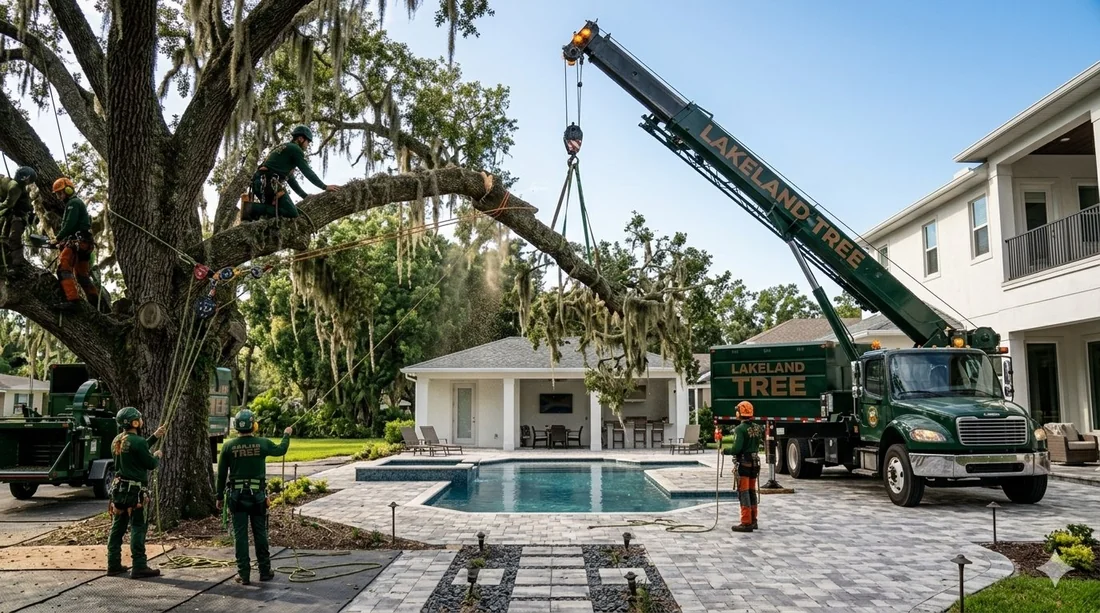
Lakeland is oak country. Live Oaks line the streets of historic Cleveland Heights and Lake Hollingsworth, Laurel Oaks dominate yards across South Lakeland, and Water Oaks are quietly cracking foundations all over Polk County. When one of these mature hardwoods needs to come down, oak tree removal in Lakeland demands specialized equipment, careful rigging, and crew that actually understands oak structure.
Heritage Live Oaks regularly exceed 60 feet tall with canopies wider than the house they shade. They’re too heavy to drop in one piece, too dense to climb safely without proper rigging, and almost always too close to a roof, pool, or driveway for conventional methods. That’s why we run a dedicated oak removal crew with crane access and a heritage-tree permit process built into every quote.
Why Oak Tree Removal in Lakeland Needs a Specialist
Three things make Lakeland oak removal harder than it looks:
- Weight. Live Oak wood is dense — a single 12-foot section of mature oak limb can weigh 1,500+ pounds. Cut it wrong and you’ve dropped a small car onto your roof.
- Permit requirements. The City of Lakeland protects grand trees, and unincorporated Polk County has its own protected-species list. Removing a regulated oak without a required permit can mean fines and replanting requirements.
- Access. Mature oaks are almost never in convenient locations — they’re between houses, over pools, around pavers, near pool enclosures. Standard crane access often isn’t possible without staging.
Our oak removal jobs typically use a combination of climbing rigging (for sections we can rope down) and crane assistance (for the heavy stuff). We’ve removed grand Live Oaks within 8 feet of screened pool enclosures with zero damage to the screen panels.
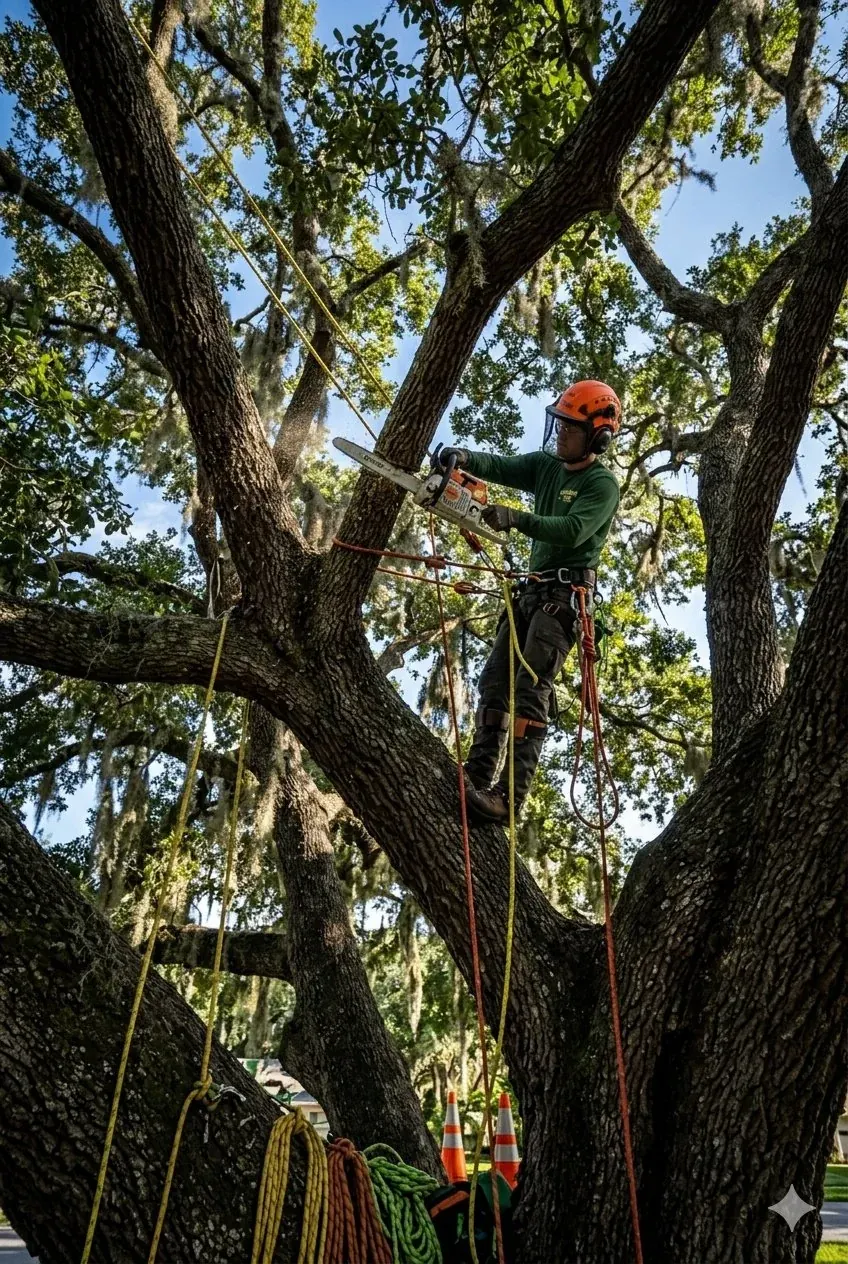
Lakeland Oak Tree Removal by Species
- Live Oak (Quercus virginiana) — the iconic Spanish-moss-draped giants. Often protected, almost always require crane.
- Laurel Oak (Quercus laurifolia) — common Lakeland yard tree, faster-growing and softer-wooded than Live Oak. Tends to fail in storms.
- Water Oak (Quercus nigra) — the silent killer of Lakeland foundations. Prone to internal rot you can’t see from outside.
- Turkey Oak, Bluejack Oak, Sand Live Oak — smaller native ridge oaks, occasionally found in Lake Wales and Polk City.
Large Oak Tree Removal Cost in Lakeland, FL
Large oak tree removal in Lakeland typically costs $1,800-$3,500. Specific factors:
- Height: 60-70ft → $1,800-$2,400 // 70-85ft → $2,400-$3,200 // 85ft+ → $3,200+
- DBH (trunk diameter): Each additional foot of trunk diameter typically adds $200-$400
- Crane required: Adds $400-$800 depending on staging
- Permit fees: $35-$150 depending on Lakeland vs unincorporated Polk County
- Stump grinding (optional): Large oak stumps run $250-$400 to grind
Laurel Oak Removal Lakeland: Lifespan and Failure Signs
Laurel oaks are everywhere in Polk County neighborhoods because they grow fast and give quick shade. The tradeoff is a short life. University of Florida IFAS lists the laurel oak lifespan at about 50 to 70 years, and notes that trunks and large branches often hollow from decay as the tree approaches 50. Even a small trunk wound or a poor pruning cut can start a column of decay that runs 10 to 20 feet or more inside the trunk. Live oaks, by comparison, resist decay far better and live much longer.
That means many of the laurel oaks planted when older subdivisions in Winter Haven and Lakeland were built are now at the age where failures become common. Signs worth a closer look:
- Cavities, open seams, or cracks in the trunk or large limbs
- Mushrooms or shelf-like conks near the base or on roots
- Large dead limbs high in the canopy
- Dark, oozing patches on the lower trunk
- A new lean or lifted soil on one side after a storm
Some of these can be managed with oak tree trimming; advanced trunk decay usually cannot.
Oak Wilt vs. Oak Decline: A Lakeland Oak Tree Service Guide
Oak wilt is a well-known killer of oaks in Texas and the Midwest, and homeowners often ask about it here. According to the Florida Department of Agriculture and Consumer Services, oak wilt has not been detected in Florida. When a Central Florida oak dies, the cause is usually a combination of stresses the state forest health program groups together: root disease fungi such as Armillaria, Ganoderma, and Phytophthora; drought or flooding; and root damage from construction, trenching, or grade changes.
A few specifics are useful to know:
- Root rot fungi often enter living roots after they are cut or damaged during construction, so decline can show up years after a driveway, pool, or addition goes in.
- A bleeding basal canker linked to Phytophthora cinnamomi has been confirmed on laurel oaks.
- Hypoxylon canker, the gray or tan crust seen on dying oak bark, is an indicator of a stressed tree more than the cause of its death.
Declining oaks rarely recover once root rot is advanced. Our guide to signs your tree is dying covers early symptoms, and we assess oaks for removal across Auburndale and the rest of Polk County.
Live Oak Removal in Lakeland: Protected Oak Permit Rules
Whether you need a permit to remove an oak depends on which city the tree sits in, and the rules are not the same from town to town:
- Lakeland: the City regulates living pines 12 inches in diameter and larger plus listed species at 6 inches and up. Ask the City of Lakeland Parks and Recreation tree crew (863-834-2233) whether your oak species is on the list.
- Winter Haven: the City has a tree removal permit, but single-family detached and duplex residential uses are exempt, as are dead, diseased, or fallen trees.
- Lake Wales: a permit is required to remove a tree at least 4 inches in diameter at 4.5 feet and 15 feet tall. See oak tree removal in Lake Wales for more.
- Plant City: native trees 5 inches and larger are protected, and grand trees of 30 inches and larger get extra scrutiny.
Statewide, Florida Statute 163.045 lets owners of single-family homes remove a tree without a local permit when an ISA certified arborist or Florida licensed landscape architect documents that it poses an unacceptable risk. Once the oak is down, large oak stumps are the slowest to grind, so plan for oak stump grinding as a separate line item.
Oak Tree Removal Near Me: Lakeland & Polk County Cities
We provide oak tree removal throughout our service area. See local details, neighborhoods, and FAQs for your city:
- Oak tree removal in Lakeland, FL
- Oak tree removal in Winter Haven, FL
- Oak tree removal in Auburndale, FL
- Oak tree removal in Bartow, FL
- Oak tree removal in Mulberry, FL
- Oak tree removal in Plant City, FL
- Oak tree removal in Polk City, FL
- Oak tree removal in Lake Wales, FL
- Oak tree removal in Haines City, FL
- Oak tree removal in Davenport, FL
- Oak tree removal in Lake Alfred, FL
- Oak tree removal in Eagle Lake, FL
- Oak tree removal in Fort Meade, FL
- Oak tree removal in Dundee, FL
- Oak tree removal in Lake Hamilton, FL
- Oak tree removal in Kathleen, FL
- Oak tree removal in Highland City, FL
Get a Free Lakeland Oak Tree Removal Quote
Free on-site estimates, written quotes within 24 hours, and zero pressure. Call us or submit the form below.
Get a Free Oak Removal Quote →Oak Tree Removal Lakeland FAQs
Large oak tree removal in Lakeland typically costs $1,800-$3,500 for heritage Live Oaks over 60 feet. Cost factors include height, trunk diameter (DBH), proximity to your house or pool, whether crane access is needed, and whether the City of Lakeland requires a grand tree permit.
Probably yes, if it’s a Live Oak above a specified DBH or located within City of Lakeland limits. Laurel Oaks and Water Oaks are less commonly regulated but should always be checked. We handle all permit research at no extra cost.
Yes. This is the most common scenario for Lakeland oak removal. We use a combination of crane assistance and roped rigging to remove large limbs and trunk sections one at a time, with full property protection.
We assess every oak before work begins. If a tree is too unsafe to climb (advanced heart rot, structural failure, ganoderma at the base), we go crane-only. Most Lakeland oak failures we see could have been predicted — ask us during the estimate.
A typical 70-foot Live Oak removal takes 6-8 hours with crane assistance, or a full day if access is tight. Multi-day jobs are rare unless we’re removing multiple heritage oaks at once.
UF/IFAS puts the laurel oak lifespan at about 50 to 70 years, and trunks often begin hollowing from decay as the tree nears 50. Live oaks typically live far longer and resist decay better.
According to the Florida Department of Agriculture and Consumer Services, oak wilt has not been detected in Florida. Dying oaks here are more often affected by root rot fungi, drought or flood stress, and construction damage to roots.
It is often Hypoxylon canker, which Florida forest health officials describe as an indicator of a stressed or declining oak rather than the main cause of death. A tree showing it deserves an inspection for root or trunk decay.
If a mature laurel oak has cavities, conks at the base, or large dead limbs near your home, removal is often the safer choice because internal decay is common and hard to see. A sound, younger laurel oak may only need structural pruning.
Live oaks are generally considered much more wind-resistant, and UF/IFAS describes the native live oak as a storm survivor when it has room and good care. Laurel oaks are more prone to decay, which weakens them in high wind.
Usually not for a house lot: Winter Haven exempts single-family detached and duplex residential uses from its tree removal permit. Commercial and other properties still need one, so confirm with the city. More at tree service in Winter Haven.
Oak roots can lift sidewalks, pavers, and pool decks and can grow into cracked pipes, especially with laurel and water oaks planted close to structures. Removing the tree and grinding the stump stops new root growth, though existing roots take years to decay.