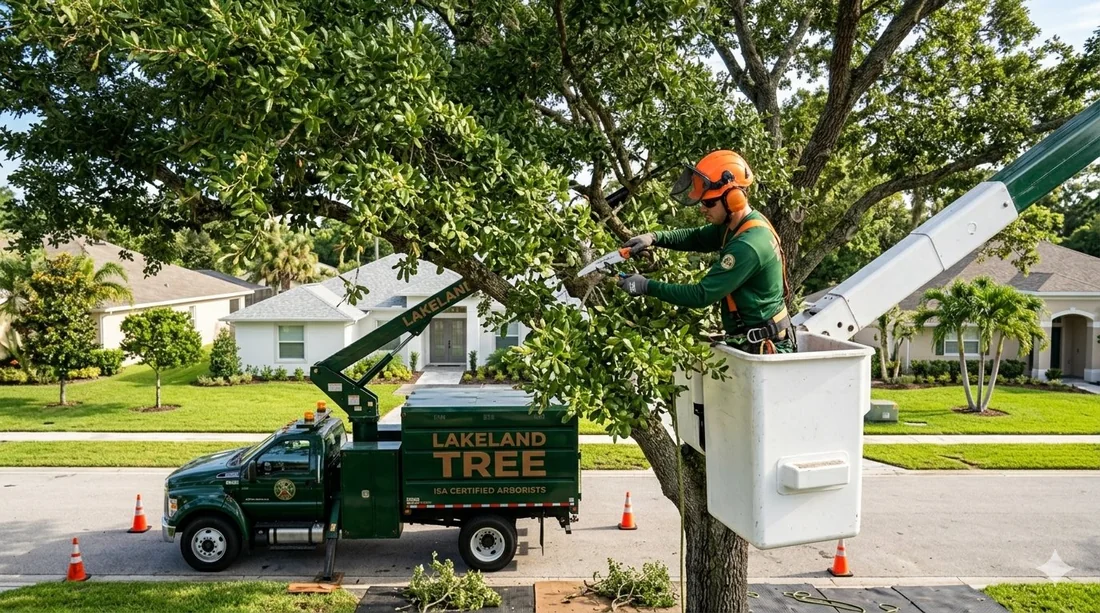
Tree trimming and pruning in Lakeland isn’t just about appearance — it’s about whether your trees survive the next hurricane. A properly thinned canopy lets wind pass through instead of catching it like a sail. Improperly trimmed trees actually fail more often than untouched ones. Knowing the difference is what separates real arboricultural work from “a guy with a chainsaw.”
Our tree trimming service in Lakeland follows current ANSI A300 industry standards: targeted deadwood removal, structural pruning of young trees, canopy thinning for wind load reduction, and clearance pruning around houses and lines. We never “top” trees, never “lion-tail,” and never “hurricane cut” palms.
Lakeland Tree Trimming: What We Do (and Don’t Do)
What we do:
- Crown cleaning — removing dead, dying, diseased, or broken branches
- Crown thinning — selective removal of live branches to reduce wind load (typically 10-20% canopy reduction)
- Crown raising — raising the lower canopy to improve clearance over driveways, walkways, or homes
- Crown reduction — reducing height/spread using proper drop-crotch cuts on lateral branches
- Structural pruning — correcting young-tree form to prevent future failure
- Hazardous limb removal — targeting specific limbs threatening structures
- Hurricane prep pruning — May-June canopy thinning before storm season
What we don’t do:
- Topping — cutting the main leader, which is the single worst thing you can do to a tree
- Lion-tailing — stripping interior branches, leaving only tip foliage (weakens the tree significantly)
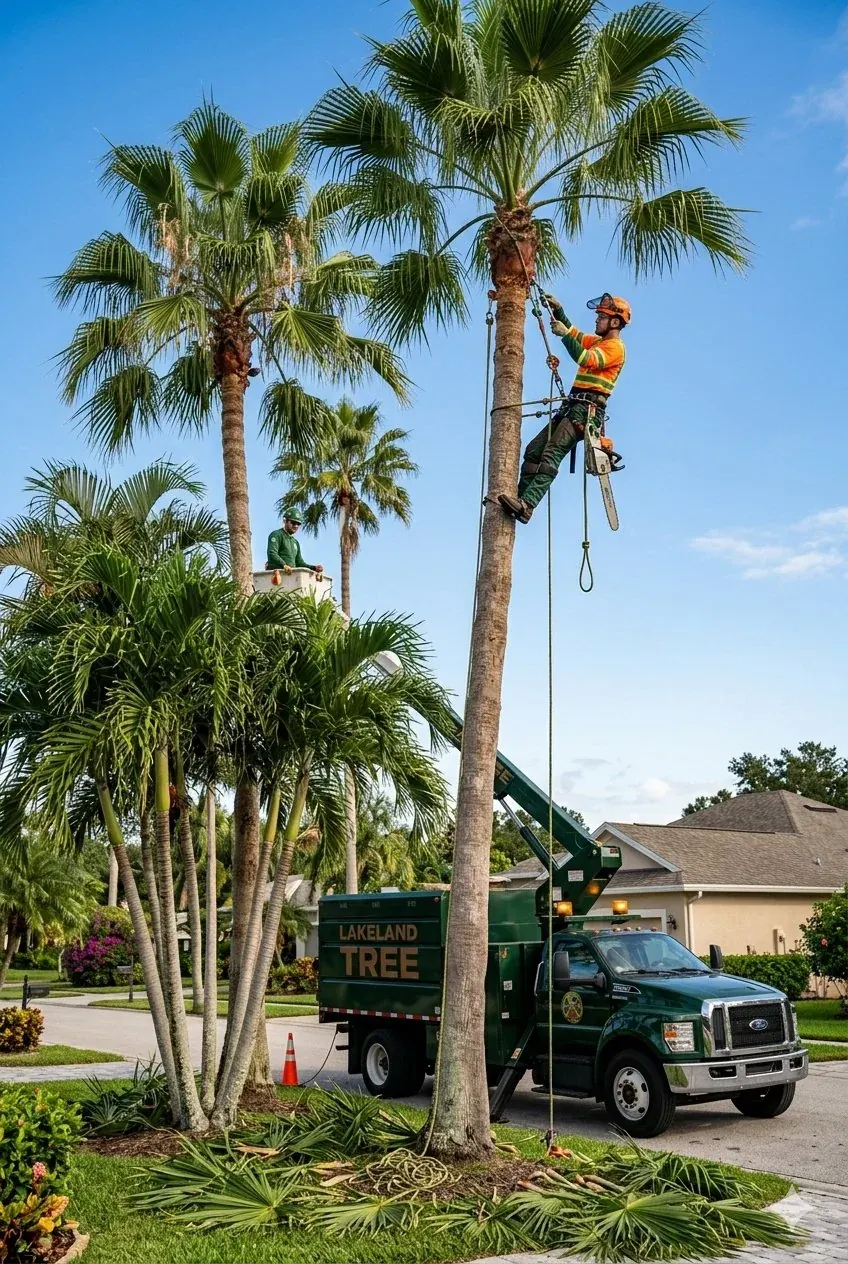
- Hurricane cuts on palms — removing all but the top few fronds (slows growth, weakens palm)
- Climbing spurs on living trees — we only use spurs on removal jobs
Hurricane Tree Pruning in Lakeland & Polk County
The best time to prune Lakeland trees for hurricane prep is May through early June — after spring growth flushes, before the first tropical storms typically arrive. Pruning during this window:
- Reduces the wind load surface area of mature oaks and pines
- Eliminates the deadwood that becomes airborne projectiles
- Allows wind to pass through the canopy rather than catching it like a sail
- Gives the tree time to seal pruning wounds before storm pathogens spread
We typically book up by mid-May for hurricane prep. Call early if you want a slot.
Tree Trimming Cost in Lakeland, FL
- Small tree trim (under 25ft): $150-$300
- Medium oak/pine trim (25-50ft): $300-$700
- Large oak hurricane prep (50ft+): $700-$1,200
- Heritage oak structural prune: $1,200-$2,000
- Palm trim (per palm): $75-$300 depending on species and height
Tree Pruning Lakeland: Crape Myrtles and Oaks Without Topping
Topping, cutting a tree back to stubs at a set height, is still common in Florida yards, especially on crape myrtles. The ANSI A300 pruning standard that professional tree care in the U.S. follows treats topping and lion’s tailing as unacceptable practices for trees. UF/IFAS research on crape myrtles explains why: topping removes stored starch the plant needs, delays flowering, triggers a flush of weak sprouts from the cut ends and the roots, and leaves a branch structure more likely to break.
What to do instead:
- Crape myrtles: tip prune small outer branches, remove crossing, dead, and low limbs, and do major structural work in the dormant season from December through February, when you can see the branch structure.
- Oaks: reduce height or spread by cutting back to a lateral branch big enough to take over, rather than chopping to a stub.
- Already topped trees: sprouts can be thinned over a few years to rebuild structure.
If a tree has truly outgrown its space, removal may be kinder than repeated topping. Our oak tree removal page covers that decision. We follow these practices across tree trimming in Plant City and the rest of our service area.
Tree Trimming Near Power Lines in Lakeland & Polk County
Who trims a tree near power lines depends on which line it is and which utility serves your address. Polk County is split among several providers: Lakeland Electric in Lakeland, Bartow’s own city electric department, Duke Energy in places like Lake Wales, and Tampa Electric (TECO) in Plant City and parts of Winter Haven.
- Primary lines (the high-voltage lines on the tops of poles) are the utility’s responsibility. Duke Energy, for example, takes online requests when trees threaten primary lines and follows up within about 10 business days.
- Service drops (the wire from the pole to your house) are generally the property owner’s responsibility to keep clear. Duke Energy asks customers to call and have the line de-energized, at no cost, before any tree work near it.
- Never trim near lines yourself. Ladders, pole saws, and wet branches can conduct electricity.
For branches around a service drop, we coordinate with your utility so the line is made safe before our crew starts. Utility crews trim for line clearance, not appearance, so homeowners in Lakeland and Polk City often have us balance the rest of the canopy afterward.
Structural Pruning for Young Oaks: Tree Trimming Service in Lakeland
The cheapest time to storm-proof a tree is when it is young. UF/IFAS hurricane guidance recommends training young trees to develop a sturdy, well-spaced framework of branches along one dominant trunk. The biggest defect to correct early is codominant stems: two or more trunks of similar size growing from the same point. That union is weak, and in mature trees it is a common place for a trunk to split apart in high wind.
Structural pruning fixes this gradually. Competing stems are shortened so one leader stays in charge, branches are spaced along the trunk instead of clustered at one point, and oversized side limbs are shortened before they rival the trunk. Because the cuts are small, young trees recover quickly. UF/IFAS recommends hiring a professional for trees taller than about 15 feet.
- Young trees: small corrective cuts while branches are still thin
- Middle-aged trees: codominant stems reduced over several rounds of pruning
- Mature trees: thinning the outer canopy, not the interior, to cut wind load
Pair this with the timing tips in our hurricane tree prep checklist, and ask about palm trimming on the same visit.
Tree Trimming Near Me: Lakeland & Polk County Cities
We provide tree trimming throughout our service area. See local details, neighborhoods, and FAQs for your city:
- Tree trimming in Lakeland, FL
- Tree trimming in Winter Haven, FL
- Tree trimming in Auburndale, FL
- Tree trimming in Bartow, FL
- Tree trimming in Mulberry, FL
- Tree trimming in Plant City, FL
- Tree trimming in Polk City, FL
- Tree trimming in Lake Wales, FL
- Tree trimming in Haines City, FL
- Tree trimming in Davenport, FL
- Tree trimming in Lake Alfred, FL
- Tree trimming in Eagle Lake, FL
- Tree trimming in Fort Meade, FL
- Tree trimming in Dundee, FL
- Tree trimming in Lake Hamilton, FL
- Tree trimming in Kathleen, FL
- Tree trimming in Highland City, FL
Get a Free Lakeland Tree Trimming Quote
Free on-site estimates, written quotes within 24 hours, and zero pressure. Call us or submit the form below.
Get a Free Tree Trimming Quote →Tree Trimming Lakeland FAQs
For structural pruning of hardwoods, January-March (semi-dormant period) is ideal. For hurricane prep, May-June. Dead, cracked, or hanging limbs are safe to remove any time of year — don’t wait for a season if a limb is a hazard.
Properly done, yes — removing deadwood reduces disease pressure, thinning improves airflow, and structural pruning of young trees prevents future failure. Improperly done (topping, lion-tailing), it makes trees weaker and more dangerous.
Mature Live Oaks and Laurel Oaks typically benefit from light trimming every 3-5 years. More frequent trimming isn’t necessary unless deadwood is accumulating.
Sometimes — canopy thinning and selective hazard limb removal can significantly reduce risk. But if a tree is structurally unsafe (heart rot, severe lean, root failure), trimming won’t fix it. We’ll tell you honestly during the estimate.
Yes. All debris is chipped and hauled in our trucks. Your yard is left raked and clean.
Yes. The ANSI A300 pruning standard treats topping as an unacceptable practice, and UF/IFAS research shows it causes weak sprouts, decay at the cut ends, and branches more likely to break.
UF/IFAS recommends doing major pruning in the dormant season, December through February, when the branch structure is visible. Removing dead, crossing, or low limbs for safety can be done any time of year.
Utilities generally trim around the primary lines on top of the poles at no charge, but the service drop to your house is usually the homeowner’s responsibility. Call your utility first so they can de-energize that line before any work.
Lakeland Electric maintains trees near its lines in the city. For the line running to your house, contact Lakeland Electric about making it safe, then call us to trim the rest of the tree.
It is stripping out most of the inner branches and leaving foliage only at the ends of limbs, which the ANSI A300 standard treats as unacceptable because it shifts weight to the branch tips and weakens the tree.
Often, if it is young or middle-aged. UF/IFAS notes that codominant stems can usually be corrected over several rounds of structural pruning, while large mature trees with a split-prone union may need cabling or removal.
Yes. We handle pruning in Plant City, Polk City, and across Polk County, and can add palm trimming to the same visit.