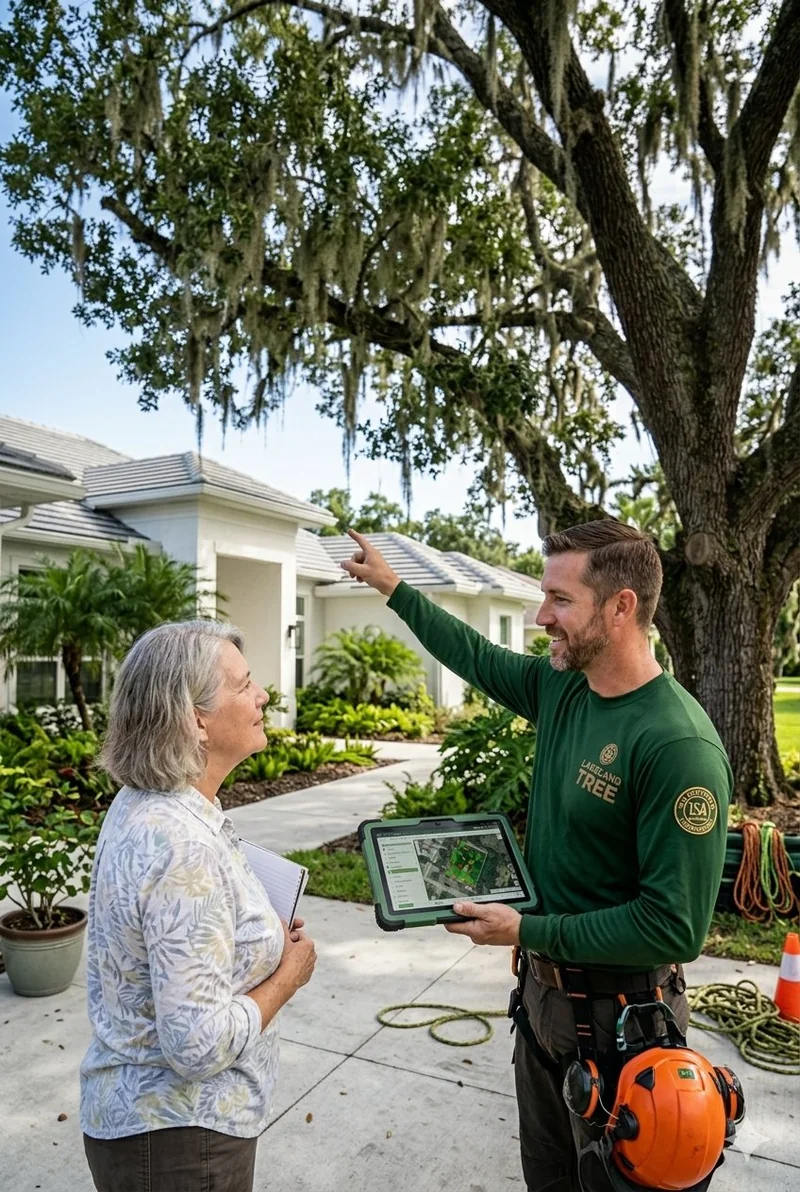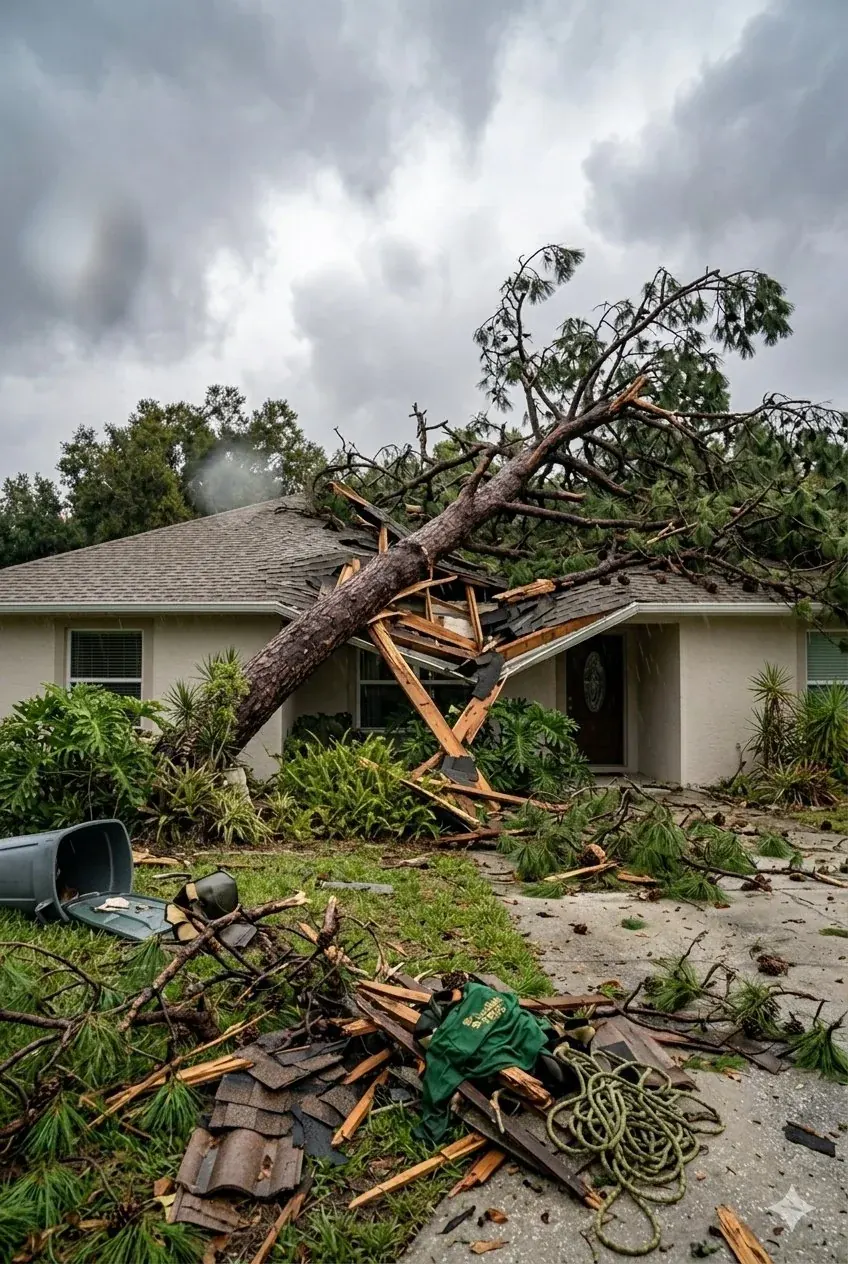
A lifted paver on the pool deck, a crack creeping across the lanai slab, a big surface root heading straight for the screen enclosure. In Central Florida, homeowners tend to blame the nearest oak. Sometimes that is right. Often the story is more complicated, and the fix can be anything from doing nothing to taking the tree down. Here is what University of Florida research says about how roots behave in our soils, which trees cause the most trouble, and when removal plus stump grinding is the answer.
Are tree roots really cracking your foundation?
Check before you cut. Dr. Ed Gilman’s UF/IFAS landscape plant guide suggests digging along the foundation first to see whether roots are even there. Many roots grow to a foundation, get deflected, and run along it rather than under it. Foundations also crack without any help from trees. Gilman notes that buildings on clay can crack as the clay shrinks in dry weather, and that the clay is sometimes several feet below sandy topsoil.
According to Gilman, roots can damage a building in two ways: by lifting it, or by pulling water out of clay soil so it shrinks. The second is mostly a clay-soil problem. On the sandy lots common around Polk and eastern Hillsborough counties, lifting of lighter structures is a bigger concern. That includes pool decks, pavers, walkways, driveways and screen-enclosure footers.
If you have a crack in a pool shell or a plumbing leak, bring in a pool contractor or plumber to find the cause before deciding the tree is guilty.
Why roots stay shallow in Central Florida’s sandy soil
A UF/IFAS Extension publication on common tree myths explains a few facts that surprise most homeowners:
- Most trees do not have a tap root. Oaks and pines can grow deep roots in sandy, well-drained soil, but not where the water table is near the surface or the soil is compacted. Trees planted in urban landscapes generally do not form tap roots.
- Roots spread far. They often reach as far from the trunk as the tree is tall, well beyond the branch tips.
- Most roots are shallow. Most tree roots are in the top 3 feet of soil, and the fine roots are concentrated in the top few inches.
Many Polk County yards have compacted fill, irrigated lawns and, in low spots, a high water table. That keeps roots toward the same shallow layer where pool decks, pavers and footers sit. A big oak 30 feet from the pool can still have roots under the deck.
The trees most likely to cause trouble
UF/IFAS tree fact sheets rate each species’ roots. Here is what they say about trees we see near pools and homes in our area:
- Live oak. Rated as able to form large surface roots. UF notes that live oak roots grow under curbs and sidewalks in tight spaces and in time lift sidewalks, curbs and driveways. UF also rates its wind resistance as very good, so it is worth keeping when there is room.
- Camphor tree. Also rated as forming large surface roots, with a note that its shallow roots can be a nuisance. UF/IFAS lists camphor as invasive and not recommended in Central Florida, which makes it an easy candidate for removal when it crowds a pool.
- Ficus (weeping fig). UF says ficus roots grow rapidly, invade gardens, and lift sidewalks, patios and driveways. Weeping fig is rated for hardiness zones 10B to 11, so freezes keep it from getting as big here as in South Florida. Sheltered ficus near a pool can still cause the classic damage.
- Laurel oak. UF rates laurel oak roots as not a problem, but its trunk can reach four feet across and the flare at the base lifts sidewalks and curbs in strips under eight feet wide. The bigger issue is lifespan: laurel oaks live 50 to 70 years and often hollow out with decay.
- Water oak. Its roots are also rated not a problem. Its life span is short, about 30 to 50 years, and many are hollow by age 40. Near a pool, the worry is usually a failing limb or trunk more than roots.
For the oaks, it helps to know which one you have. Our oak tree removal page explains how laurel and live oaks age differently.
Root pruning: how close is too close?
Cutting the offending roots is the first thing many people try. It can work, but it has real risks. Gilman’s UF guidance says experts disagree on how close to the trunk roots can be cut. A common rule is no closer than 3 times the trunk diameter, and preferably 5 times. For a 20-inch oak, 5 times means staying about 8 feet from the trunk. Larger roots, more cuts, older trees and poorly drained soil all raise the risk. Leaning trees or trees in poor health should not be root pruned at all.
Gilman is blunt that pruning roots can make trees fall over or die, and that there are fewer deep roots to hold a tree up on poorly drained or compacted soil. That describes a lot of Polk County backyards. His list of alternatives is worth reading before any cutting: curve or elevate the walkway over the roots, re-pour with steel reinforcement, grind the concrete down, or build elsewhere.
Do root barriers work?
Root barriers are vertical plastic or fabric panels set in the soil to steer roots down or away. UF research found the results depend on drainage. In better-drained soil, roots pushed under a barrier may stay deeper for several feet. In poorly drained soil, they tend to grow under the barrier and come back up on the other side. Gilman’s own research summary casts doubt on how useful barriers are.
They make the most sense when you are planting a new tree near a new deck or walk, on well-drained sandy ground. As a retrofit next to a mature oak, trenching in a barrier means cutting a lot of roots, with all the stability risks above.
When tree removal and stump grinding is the real fix
Removal is the right call more often than people expect when:
- The tree is a short-lived or decay-prone species like laurel or water oak, already crowding a pool cage or roofline.
- The damage is from the trunk flare or major structural roots, which cannot be cut without destabilizing the tree.
- The tree is invasive, like camphor, or cold-tender and outgrowing its spot, like ficus.
- Repairs such as a new deck or relaid pavers will fail again as the roots keep growing.
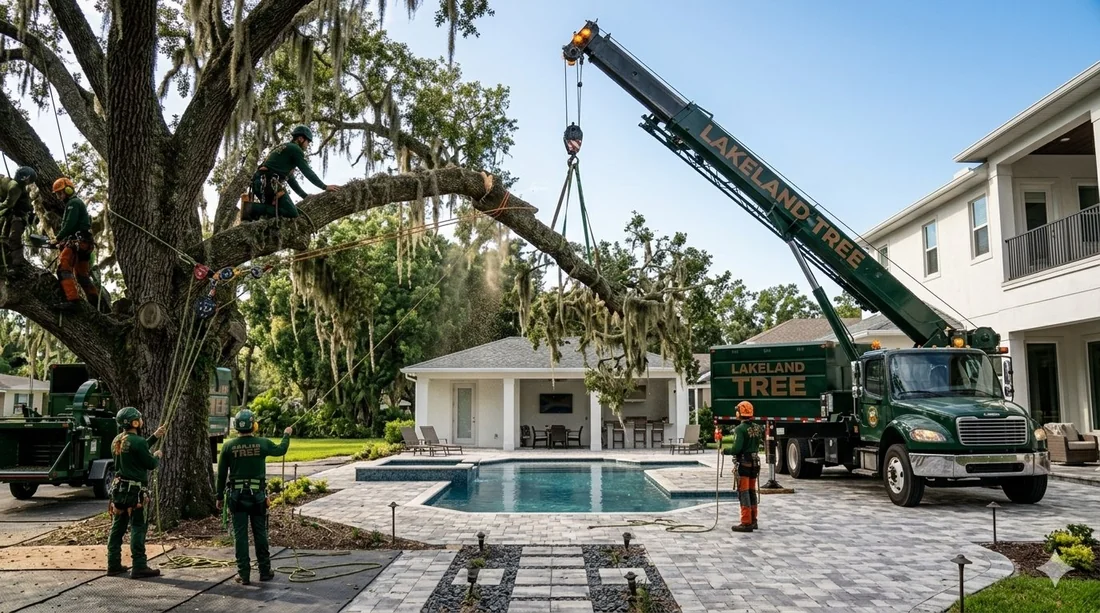
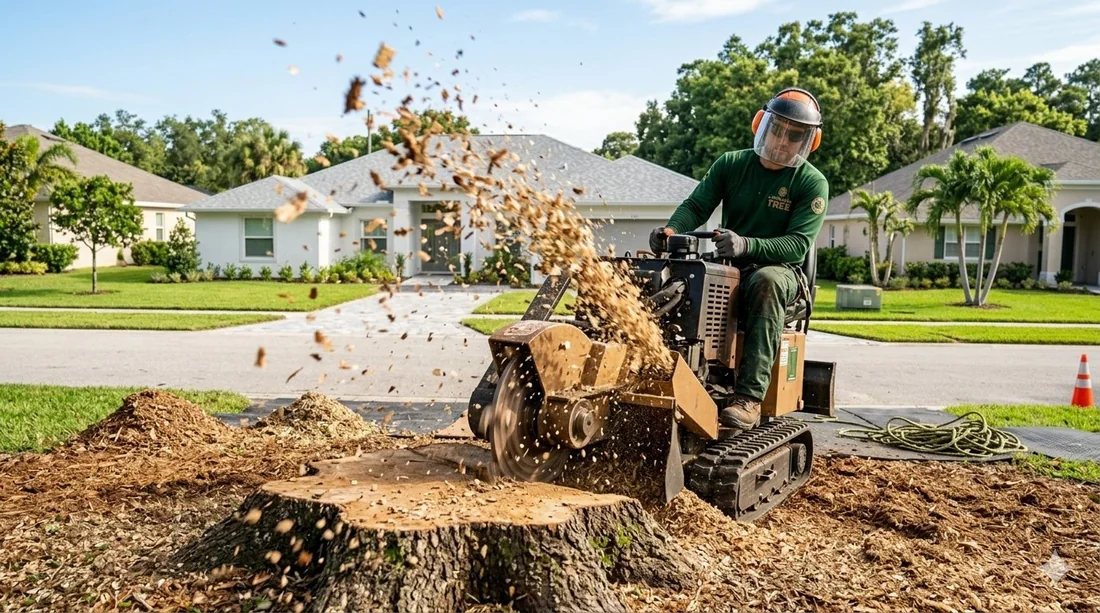
Removing a tree near a pool is careful work. Pieces are lowered on ropes or lifted out by crane, and the deck and cage are protected throughout. Our tree removal crews do this regularly. Afterward, stump grinding takes the stump and main root flare below grade so pavers or sod can go back down. The remaining roots break down over time, and you may see some settling to fill. If a builder needs all the roots out for a new slab, that is a larger excavation job.
Permits before removing a tree in Winter Haven, Plant City or Lakeland
Rules vary a lot between neighboring cities:
- Winter Haven exempts single-family and duplex homes from its tree removal permit. Tree removal in Winter Haven near a pool is usually permit-free.
- Plant City requires a permit to remove protected trees, meaning native trees 5 inches in diameter and larger. Hazardous or diseased trees are permitted without replacement. See tree removal in Plant City.
- Lakeland regulates living pines 12 inches and larger plus listed species 6 inches and larger. Check before cutting in Lakeland.
- Everywhere, Florida Statute 163.045 lets owners of single-family homes remove a tree without a local permit if an ISA certified arborist or Florida licensed landscape architect documents that it poses an unacceptable risk.
We also work in Bartow and Auburndale, where the rules differ again. Our tree permit guide covers more detail.
Roots lifting your pool deck or walkway? Call (813) 725-9787 or request a free assessment. We will look at the tree, the damage and your options, and give you a written quote if removal makes sense.
Need a Lakeland tree quote?
Free written estimates within 24 hours. No pressure, no hidden fees.
Get a Free Quote →