Taking down a tree is only half the decision. The other half is what goes in the ground next, and that choice will shape your yard for the next 50 to 100 years. Pick well and you get shade, value and a tree that rides out the next hurricane. Pick poorly and you may be paying for another removal in 30 years. Polk County has plenty of reason to care: in 2004, Hurricanes Charley, Frances and Jeanne all struck the county, and Polk County Emergency Management says it is the only county in the United States hit by a hurricane’s eye three separate times in one season.
The good news is that Florida has real data on which trees stand up to wind. Here is what the University of Florida research shows, and how to use it when replanting after a tree removal in Lakeland or anywhere else in the county.
What UF/IFAS research learned from ten hurricanes
After ten hurricanes between 1992 and 2005, a University of Florida team led by Mary Duryea surveyed urban trees street by street to see which species stayed standing. Their findings, published by UF/IFAS Extension in Wind and Trees: Lessons Learned from Hurricanes, sort common species into four groups, from highest to lowest wind resistance. A few lessons stand out for homeowners:
- Species matters. Some trees survived at much higher rates than others in the same storm.
- Groups beat loners. Trees growing in groups survived better than single trees: 80% versus 70% in Hurricane Ivan and 88% versus 78% in Hurricane Jeanne.
- Root space matters. Trees with more than about 75 square feet of rooting space survived at 91%, compared with 64% for trees squeezed into 39 square feet or less.
- Good pruning pays. In one analysis of broadleaf species, properly pruned trees survived at 73% compared with 47% for unpruned trees.
The researchers are clear that no tree is wind-proof. Soil, age, health and past pruning all play a part. But species choice is the one factor you fully control on replanting day.
The best hurricane-resistant trees for Polk County yards
These four natives land in the highest wind-resistance group on the UF/IFAS list for the Southeastern Coastal Plain, and all of them grow well in Central Florida.
Live oak (Quercus virginiana)
The classic Southern shade tree. UF/IFAS describes its wind resistance as very good once established and notes it can live for centuries when properly located and cared for. The catch is size: mature live oaks reach 60 to 80 feet tall with a spread of 60 to 120 feet, and their surface roots can lift sidewalks and driveways. Give it room, well away from the house and the slab.
Sabal palm (Sabal palmetto)
Florida’s state tree is one of the toughest things you can plant. It sits in the highest wind-resistance group on both the coastal plain and subtropical lists, and in south Florida storms it was one of the native species with high survival. It also fits small yards and tight spots where a big canopy tree would crowd the roof. For upkeep on sabals already on your lot, see our palm tree trimming and removal page.
Southern magnolia (Magnolia grandiflora)
A dense, evergreen tree reaching 60 to 80 feet with a 30 to 40 foot spread. UF/IFAS notes its roots spread unusually wide, about four times the canopy width, and that the large, slow-rotting leaves can be a litter nuisance on patios. Plant it in open lawn, not beside the pool.
Bald cypress (Taxodium distichum)
Many people picture bald cypress standing in a lake, and it fits naturally along the lake shorelines found all over Winter Haven and Lakeland. UF/IFAS lists it as tolerant of wet to well-drained soils with high drought tolerance, and notes that the knobby “knees” generally do not form on drier sites. It grows fast to 60 to 80 feet, with a narrower 25 to 35 foot spread, and it drops its needles in winter.
Smaller yards have options too. Crape myrtle and dogwood also sit in the highest group on the coastal plain list, which makes them good picks under power lines or near a patio.
Trees to think twice about replanting
These species show up on the lowest wind-resistance list, and several of them are already common in older Polk County neighborhoods:
- Laurel oak. Fast shade, short life. UF/IFAS notes a typical lifespan of about 50 years, with decay and disease often showing as the tree nears 40. In Panhandle hurricanes, laurel oaks survived worse than live oaks and sand live oaks. Our guide to laurel oak vs. live oak storm damage explains how to tell them apart.
- Water oak. Also in the lowest group, and like laurel oak it is a short-lived tree in UF/IFAS tables.
- Sand pine. Native to the scrub of the Lake Wales Ridge, but it had just 43% survival after Hurricane Ivan, the lowest of the pines studied except spruce pine. If you want a pine, slash pine (71%) and longleaf pine (57%) did better and sit in the medium-high group.
- Queen palm. A popular nursery palm, but UF/IFAS places it in the medium-low group and lists it among the exotic species with low survival in south Florida hurricanes. It also carries a “manage to prevent escape” caution in the UF/IFAS invasive assessment. A sabal is the sturdier swap.
If one of these is already standing near your house, it does not have to come down tomorrow. But it is worth a look before storm season, and a poor choice to plant again.
Stump grinding in Lakeland before you replant
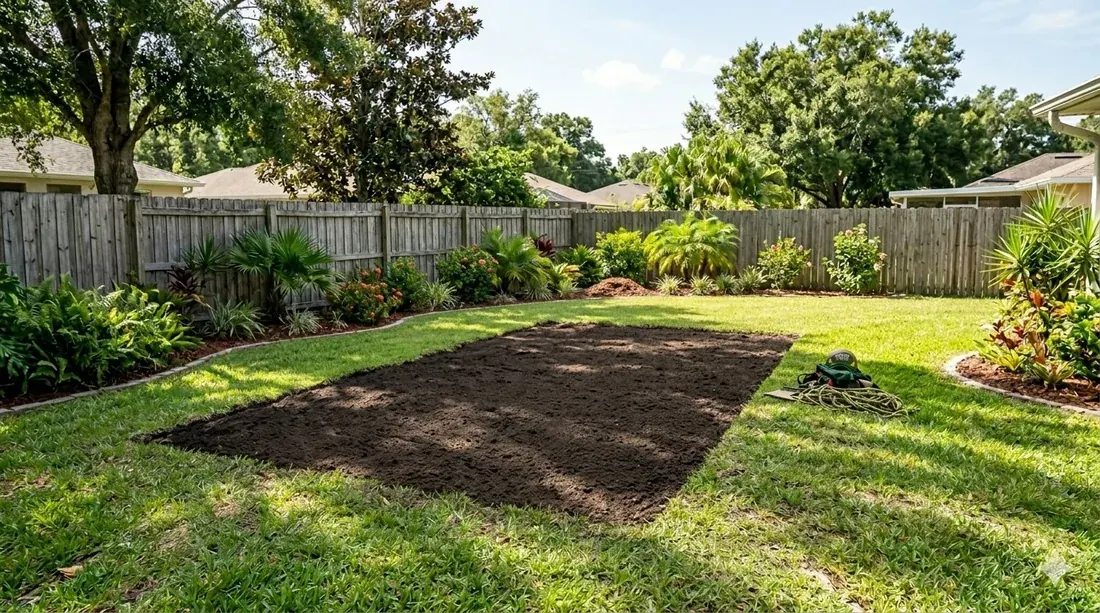
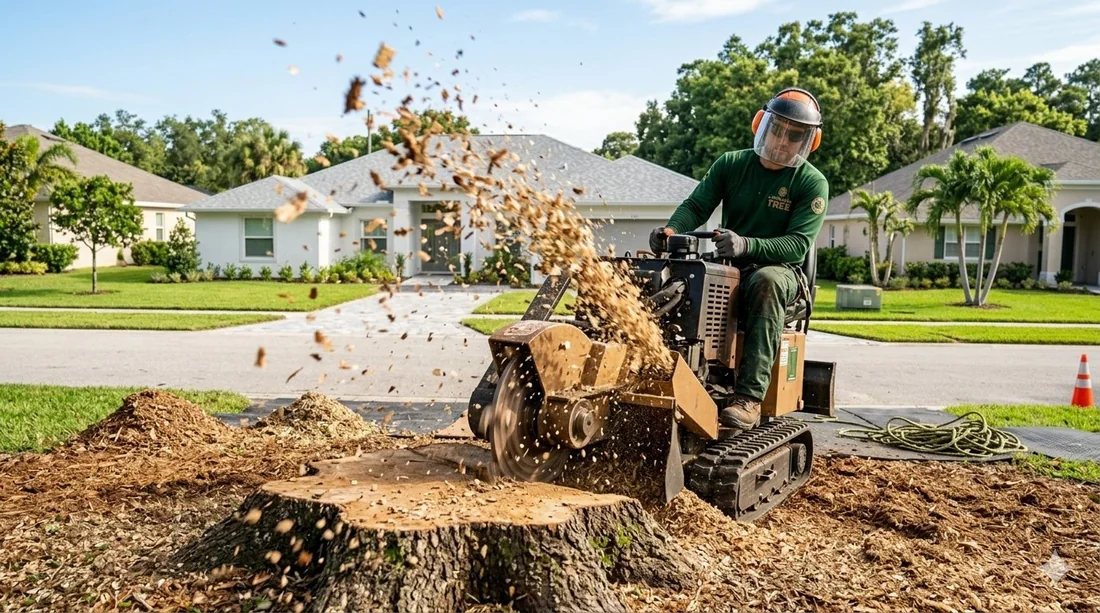
You cannot plant a new tree on top of an old stump. Grinding it out clears the spot and leaves a bed of chips you can rake away and replace with soil. If you want the new tree in the same general area, plant it offset from the old stump site so the roots start in clean soil rather than decaying wood. Our stump grinding service covers the whole county, from stump grinding in Bartow to stump grinding in Auburndale, and we can flag where remaining roots are likely to be before you dig.
Where to plant: rooting space, spacing and groups
UF/IFAS gives simple minimums for rooting space: about 10 by 10 feet for small trees, 20 by 20 feet for medium trees and 30 by 30 feet for large trees. It also recommends at least 3 feet of soil depth over a deep water table. A few practical rules for a typical Polk County lot:
- Keep large-canopy trees like live oak and southern magnolia well away from the house, pool deck and driveway.
- Plant small trees such as crape myrtle under or near overhead lines, not big oaks.
- When you have space, plant in clusters. UF/IFAS recommends groups of at least five trees rather than singles.
- Protect roots on the trees you keep. UF/IFAS advises never cutting roots closer to the trunk than five times the trunk diameter.
Lot sizes vary a lot across our service area. A roomy acreage lot near tree service in Plant City can hold a grove of live oaks, while a smaller lot in a newer Winter Haven subdivision may be better suited to a pair of sabals and a crape myrtle.
Arborist advice on pruning the new tree
A wind-resistant species still needs good structure. UF/IFAS Gardening Solutions suggests pruning a young live oak every year for the first five years, then every three years until it is about 30, removing competing trunks and branches that form narrow angles with the trunk. That early work is inexpensive compared with fixing a split trunk later. Our tree trimming service handles structural pruning on young trees, and our hurricane tree prep checklist covers what to do with the mature trees around them each spring.
Removal and replanting across Polk County
If you are on the ridge near tree removal in Lake Wales, the deep, dry sand once carried longleaf pine and scrub oaks, so drought-tolerant choices make sense. UF/IFAS rates bald cypress as highly drought tolerant as well as flood tolerant, which makes it a flexible pick for both ridge lots and lower, wetter lots near lakes. Either way, check local permit rules before any removal. Some cities regulate certain trees, and we can tell you what applies at your address.
Ready to swap a risky tree for a better one? Call (813) 725-9787 or request a free quote and we will walk the yard with you, price the removal and stump grinding, and point out the best spots for replanting.
Need a Lakeland tree quote?
Free written estimates within 24 hours. No pressure, no hidden fees.
Get a Free Quote →