After a storm rolls through Polk County, the oaks that end up in driveways and on roofs are rarely a random mix. More often than not, the big broken limb or split trunk belongs to a laurel oak, while the live oak next door is missing some small branches but still standing. Knowing which oak you have tells you a lot about how it will age, how it is likely to fail and whether it needs pruning or removal. Here is a practical guide for homeowners in Lakeland and the surrounding towns.
Two oaks that are easy to mix up
Laurel oak (Quercus laurifolia) and live oak (Quercus virginiana) are both native, both common in Central Florida yards and both have narrow, unlobed leaves that do not look like the classic “oak leaf” most people picture. From the street, a young laurel oak and a young live oak can look almost the same. The differences become obvious once you know where to look, and they matter because the two trees behave very differently over time.
How to tell a laurel oak from a live oak
- Leaf shine. UF/IFAS describes laurel oak leaves as smooth, narrow and shiny on both sides. Live oak leaves are glossy dark green on top but paler underneath, and the underside is sometimes fuzzy. Flip a leaf over: if both sides shine the same, lean toward laurel oak.
- Leaf length. Laurel oak leaves run about 3 to 5 inches. Live oak leaves are usually about 2 to 5 inches, so length alone will not settle it.
- Winter behavior. Live oak holds its old leaves until the new ones come in, so it looks evergreen all year. UF/IFAS lists laurel oak as semi-evergreen to deciduous: it keeps its leaves through much of the winter but does not carry them year-round the way a live oak does.
- Shape. Laurel oaks grow taller than they are wide, with an oval crown and a 35 to 45 foot spread. Mature live oaks grow outward, with a spread of 60 to 120 feet and long, low, sweeping limbs.
- Bark. Laurel oak bark is dark gray and fairly smooth when young, later developing shallow fissures with flat ridges. Live oak bark becomes rough, deeply furrowed and blocky, nearly black on old trees.
- Acorns. Laurel oak acorns are small and round, about 1/2 inch, sitting in a shallow, saucer-like cap. Live oak acorns are longer, about 3/4 inch, dark brown, with a bowl-shaped cap covering about the top third.
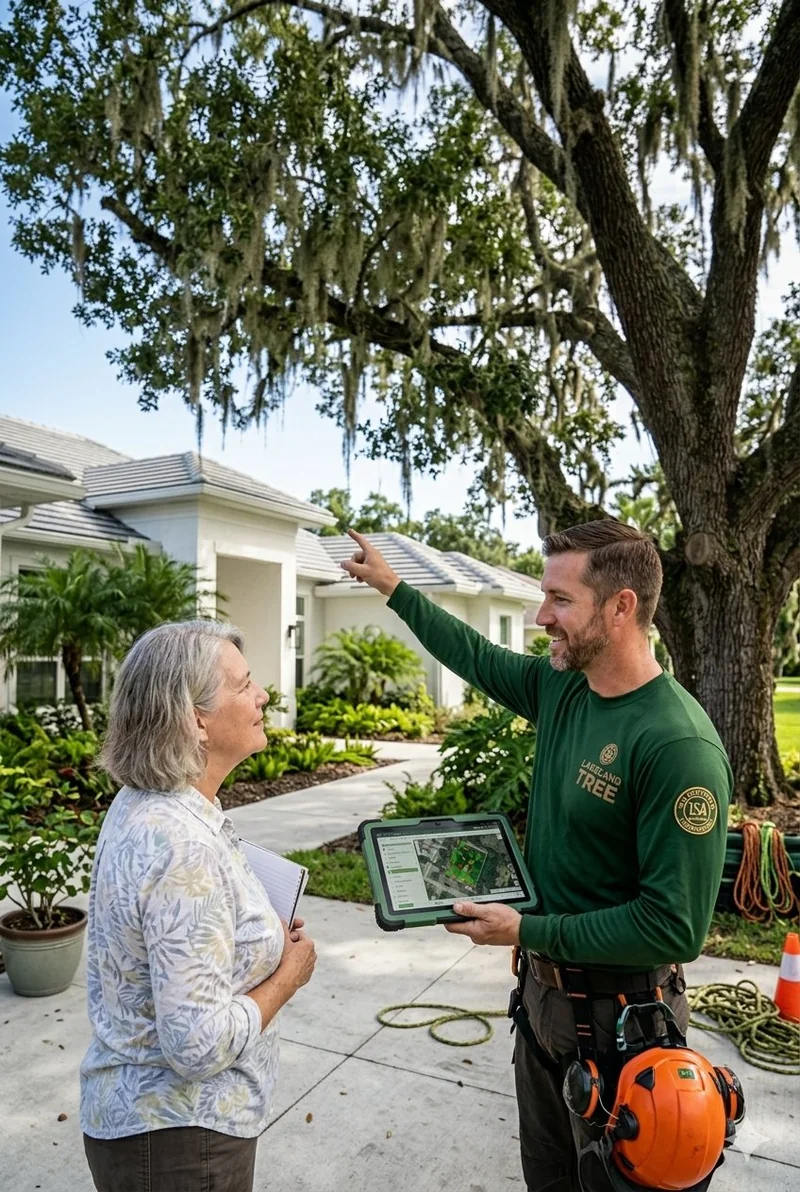
If you are still unsure, bring a few leaves and acorns to an estimate and we will help you sort it out.
Lifespan: decades versus centuries
This is the biggest difference between the two trees. UF/IFAS fact sheets put the laurel oak lifespan at 50 to 70 years, and the UF/IFAS hurricane research team notes that laurel oaks often begin showing decay and disease around age 40. Live oaks, in contrast, can measure their lives in centuries when they are well placed and cared for. An older UF/IFAS guide to Florida oaks notes that live oaks frequently pass 200 years and that specimens over 500 years old have been documented.
In practical terms, many laurel oaks planted when older Polk County subdivisions went in are now at the end of their useful life, while the live oaks planted at the same time are just reaching maturity.
How each oak fails in a storm
Laurel oak: hidden decay and sudden breaks
Laurel oak ranks in the lowest wind-resistance group on the UF/IFAS list for the Southeastern Coastal Plain. The main reason is decay. UF/IFAS notes that small wounds on a laurel oak can start columns of decay 10, 20 or more feet long inside the trunk, and that trunks and large branches often hollow with age. A laurel oak can look full and green while its trunk or a main limb is largely hollow, and those weakened sections are what snap in high wind. In four Panhandle hurricanes, UF researchers found laurel oaks survived at lower rates than both live oaks and sand live oaks.
Live oak: branch loss, but usually still standing
Live oak sits in the highest wind-resistance group, and UF/IFAS rates its wind resistance as very good once established. When live oaks do lose parts in a storm, it is more often individual branches than the whole tree. The weak points are structural: UF/IFAS warns that multiple trunks and branches forming narrow angles with the trunk are likely to split, and that codominant stems can develop included bark, a weak union that breaks easily. UF/IFAS surveys also found that larger-diameter trees lost a greater share of their branches than small trees, so a big old live oak still benefits from regular deadwood and structural pruning.
An honest caveat for Central Florida
The same UF/IFAS research found that in two south Florida hurricanes, Charley and Jeanne, survival and branch loss for laurel, live and sand live oaks were similar. Both storms struck Polk County in 2004. The researchers suggested local differences in the trees and sandier soils as possible reasons. The lesson: species is a strong guide, but the condition of the individual tree matters just as much.
Remove or prune? A decision guide for oak trees
Use these as starting points, then get a trained eye on the tree itself.
Pruning is usually the right call when:
- The oak is a live oak with a sound trunk and good structure, but has deadwood, low limbs over the roof or crossing branches.
- It is a young tree of either species with two competing trunks or narrow branch angles that can still be corrected.
- A laurel oak is younger and solid, with no cavities, conks or seams, and simply needs deadwood removed and weight reduced on long limbs.
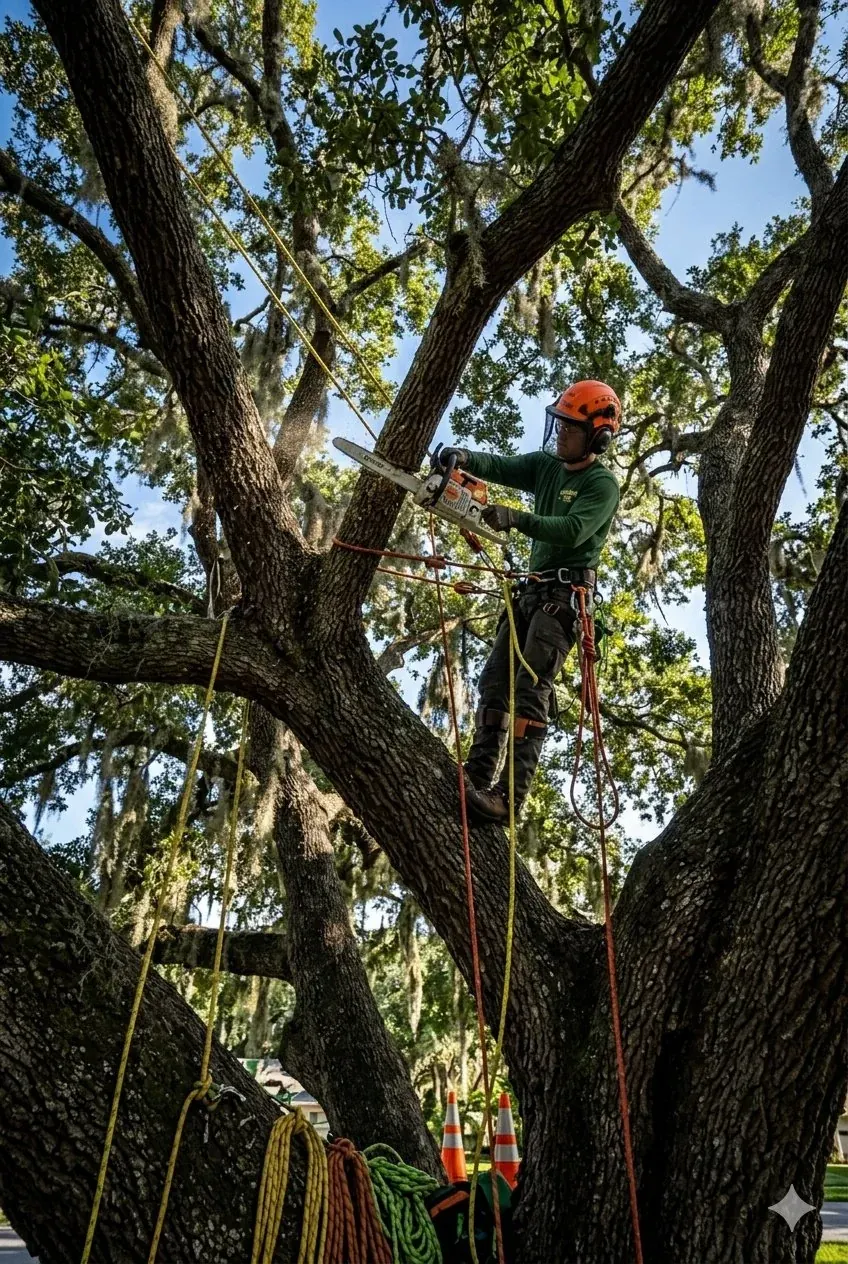
Professional tree trimming for oaks means selective cuts that remove deadwood and weak branches without stripping the canopy. UF/IFAS advises pruning regularly so only small branches need to be removed, since large pruning wounds invite decay, and that is especially important on laurel oaks.
Removal is usually the safer call when:
- A mature laurel oak has cavities, open seams, mushrooms or conks at the base, or large dead limbs, and it stands within reach of the house, pool or driveway.
- The trunk has split at a codominant union, on either species.
- The tree has developed a new lean or lifted soil on one side after a storm.
- More than one major limb has already failed.
When it is time, our oak tree removal service covers the rigging, permits research and cleanup, and stump grinding can be added to the same quote. Permit rules differ by city, so check before cutting. Our Lakeland tree permit guide covers the basics.
Emergency tree service when an oak splits
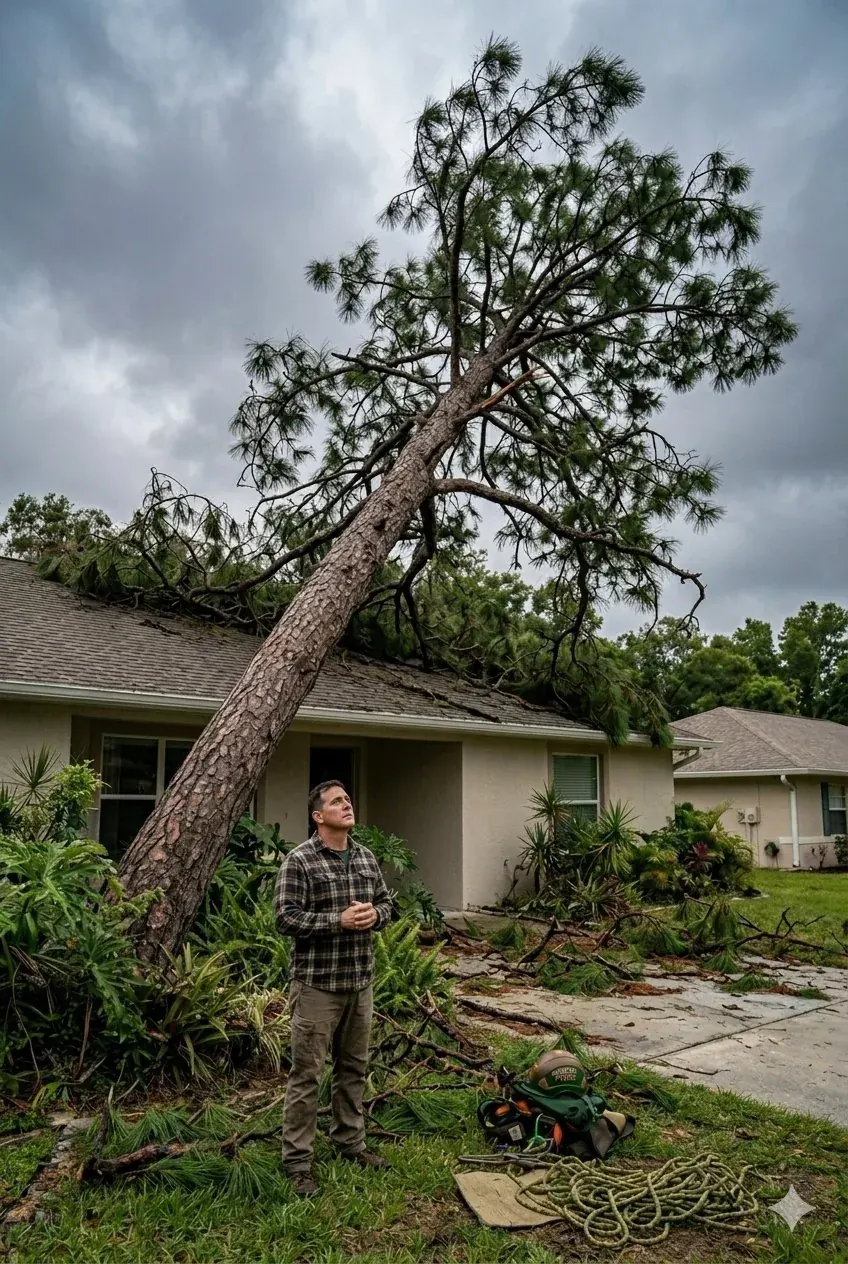
If an oak limb or trunk has come down on your home, car or fence, or is hanging over a structure, keep people away from the area and stay well clear of any downed power lines. Call your electric utility first if lines are involved. Then call our 24/7 emergency tree service line. Take photos before anything is moved, since documentation helps with insurance claims. A partly split oak can shift without warning, so do not try to cut a loaded limb yourself.
Oak tree removal and trimming across Polk County
Oaks are part of the landscape everywhere we work. We handle oak tree removal in Lakeland, where large oaks shade many older neighborhoods, and tree trimming in Bartow, the city that calls itself the City of Oaks and Azaleas. We also cover tree removal in Winter Haven, tree service in Plant City and Mulberry tree services. If you are replacing a laurel oak, our guide to hurricane-resistant trees to plant can help you choose something that will last.
Not sure which oak you have, or whether it can be saved? Call (813) 725-9787 or request a free quote. We will identify the tree, look for decay and weak unions, and give you a straight answer on pruning versus removal.
Need a Lakeland tree quote?
Free written estimates within 24 hours. No pressure, no hidden fees.
Get a Free Quote →